Underwater
Paradox
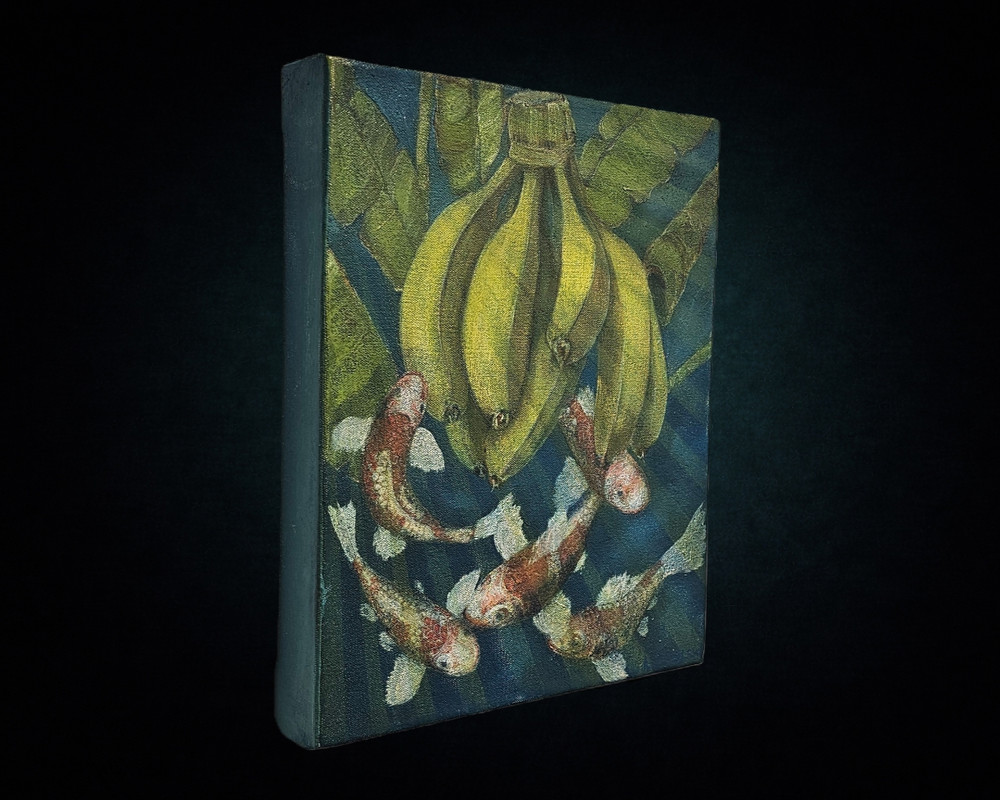
Underwater, in a quiet depth, lie bananas. Their yellow skins, like forgotten sunlight, gently glow through the water's thickness. Around them swim koi fish, moving slowly, as if in a ritual dance.
The Depth and the Yellow Light
Underwater, in a quiet depth, lie bananas. Their yellow skins, like forgotten sunlight, gently glow through the water's thickness. There is something of a memory here — the warmth of an object that does not belong, preserved by the cold pressure of the deep.
Under the emerald and infinite blue, the yellow does not vanish — it insists. It glows not as a provocation but as a question: what does it mean to remain oneself in a space that was never designed for you?
The Koi and the Ritual of Motion
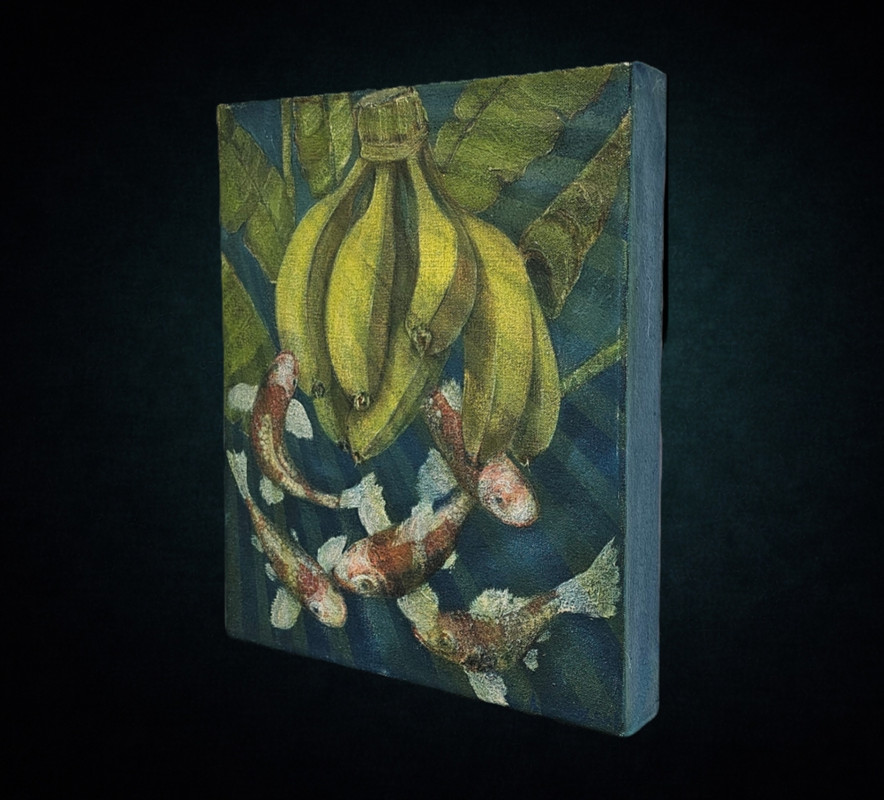
Around them swim koi fish, moving slowly, as if in a ritual dance. Their fins cut through the weightlessness of the water like thin blades of time, drawing a boundary between the past and the present.
The fish, meanwhile, are life itself — its constant motion, its striving to find a way despite obstacles. They circle the bananas like guardians of a secret, as if they know something that remains hidden from view. There is a Jungian quality to this guardianship: the unconscious protecting what the conscious mind has not yet named.
Snow Beneath the Surface
Yet this scene, hidden in the underwater world, is illuminated by snow. Its crystals, pierced by the sun's rays, touch the water, dissolve, vanish, turning into an invisible caress. This is no ordinary snow — it feels like a metaphor for something that must melt away, giving space to something new.
Under its light, the water takes on a strange hue: perhaps a deep emerald, perhaps a transparent, infinite blue. The snow descends into an element it cannot survive — and in that dissolution, becomes something else entirely. Transformation through surrender.
The Paradox — Synchronicity
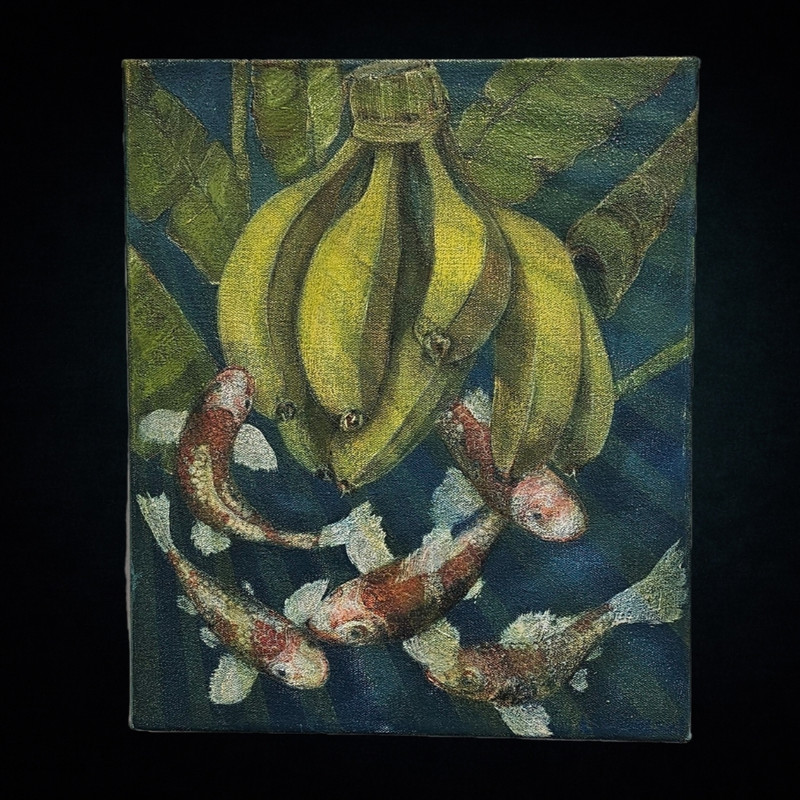
Bananas underwater are a paradox, a coincidence, synchronicity. They remind us that the material can exist where it seemingly does not belong. In Jung's sense, synchronicity points to a meaningful coincidence — an alignment between inner state and outer event that logic cannot account for, yet the psyche recognises as true.
Symbols of the Work
The canvas holds a Jungian grammar. The banana — warm, terrestrial, absurd in its context — is the abandoned idea that refuses to stay abandoned. The koi — creatures of patient beauty — are the psyche's guardians, moving in the space between knowing and not-knowing.
The water is not simply a medium. It is the unconscious itself, vast and pressure-bearing, through which all images travel changed. And the snow that enters it does not survive as snow — it becomes the very substance of the light that now allows us to see.
Together they form a field. Not an illustration of an idea, but an image that holds the tension between opposites: above and below, warm and cold, belonging and exile, the familiar and the impossible.
The Sun as Hope
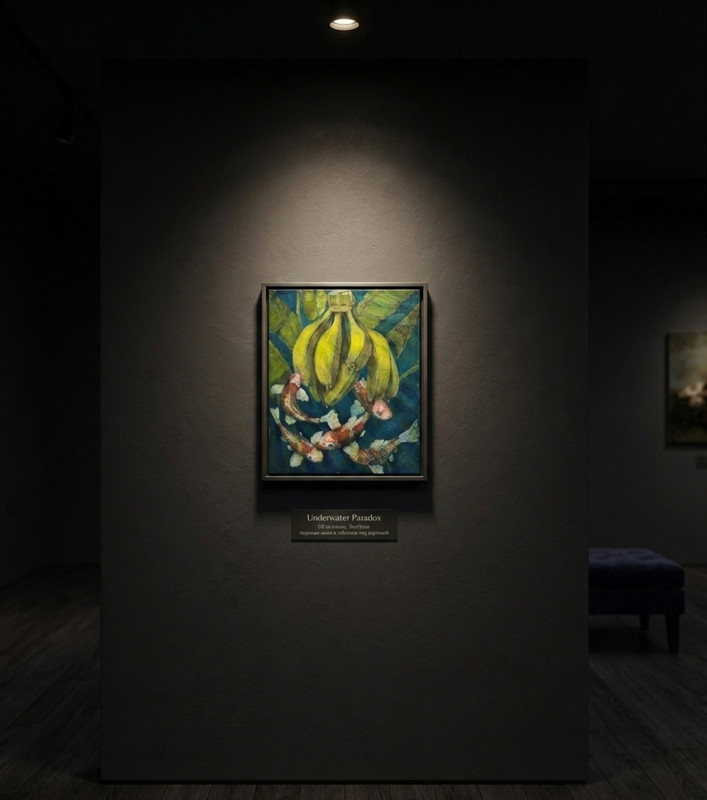
The sun breaking through the snow becomes a symbol of hope, of light that always finds its way, even in the most unlikely places. It is a reminder that life will always find a way to assert itself, even if it needs to illuminate the bottom of an underwater world.
This is the anthroposophic thread woven through the canvas: the spiritual light that does not stop at the boundary between elements, that passes through the impossible medium and reaches what waits in the darkness below. Not as salvation — but as the simple insistence of light upon existing.
The painting does not resolve its paradox. It holds it. The banana does not belong — and yet it glows. The snow should not survive descent — and yet it becomes light. The koi should not guard something that makes no sense — and yet they circle, patient, knowing something we have not yet been told.
This work was painted as an act of listening — to the unconscious, to the image that arrived before any explanation was ready for it. The decision to place bananas underwater was not made rationally. It arrived. And in the Jungian sense, when an image arrives with that kind of insistence, the honest response is not to explain it away but to paint it, to hold it, to let it be witnessed.
The text was created with the help of the Akashic Digital Chronicler — an attempt to build a language adequate to the image, not to translate it into something safer or more reasonable, but to accompany it into its own depth.
Some images are paradoxes. They do not belong where they are. That is precisely why they glow.