The Film · 5 min 12 s
Twenty-one years, two cities, one stranger seen again and again — and two mornings on the same Dublin doorstep that turned the one who watched into the one who was struck. Five minutes that hold the whole thread: from a boutique in Riga to the corner of Dorset Street, through a dream, a handful of photographs and an attempt to measure the improbable.
The full story, in detail, follows below
Documentary Essay · Dublin · November 2021
Archive of the Codex · From the Series: Synchronicity · Part 2
Trembling
on Dorset Street
A documentary essay.
First I saw someone else's trembling hands.
The next morning, in the same place,
it was my hands that trembled.
↓ scroll ↓
TWO MORNINGS / ONE THRESHOLD
Through the photograph.
Drag the image to move forward or back. You can also scroll. Pause wherever you wish.
Through the photograph.
This sequence is short. It contains almost the whole story. But to explain why it mattered, one must begin in a different city and a different era. And one must be prepared for the explanation not to close — but to open outward, toward questions that have no answer within the ordinary understanding of how reality is structured.
Riga, c. 1998–2000 — The Boutique on Gertrudas Street
Working in a branded clothing boutique called "Venezia," at the intersection of Gertrudas and Baznīcas streets, Riga. A space oriented toward the external: fabric, silhouette, hanger, display window, the customer's gaze.
A man who came periodically. Did not buy. Did not browse with intent. He moved through the space differently — slowly, almost ritually, as if examining clothes the way others look at paintings.
He was forgotten immediately after. Or so it seemed.
One man appeared periodically in our section. I cannot reconstruct his exact portrait. Memory preserved not a face but a type: something about him was not like the ordinary customers. Not the appearance itself, but the way he existed in the space of the shop. He moved slowly, almost ritually, through the clothing racks. Not choosing. Not buying. Simply looking — with that particular unhurriedness that transforms ordinary action into something resembling ceremony. He moved from one item to another, held things for a long time, returned them, took them again.
He examined clothes the way others look at paintings.
From a practical standpoint, this was inconvenient. A shop worker feels occupied, time passing — and there will be no purchase. Irritation was a natural response. But precisely this strangeness — this slowness, this absence of the consumer gesture — made him a figure that remained. Not because he did something important. But because he did not coincide with where he was.
That is what I thought.
Dublin, c. 2019 — Brown Thomas, Grafton Street
More than twenty years passed. I was living in Dublin. One day — approximately 2019, I cannot reconstruct it more precisely — I went into Brown Thomas on Grafton Street and descended to the menswear floor.
There was not a second of doubt — but before it became a thought, it was something bodily. A hand moving a hanger. The same slowness. The same concentration resembling ritual. The same way of being among objects — not as a customer, but as someone else entirely. Recognition happened before consciousness could verify it: the body remembered before memory produced its evidence.
This is kinesthetic memory in Merleau-Ponty's terms — that form of knowledge stored not in words and images but in motor schemas of perception. More than twenty years earlier, the body had memorised the rhythm of another's movement — and now it silently identified it, without the mediation of reason.
I stopped. The shock was physical: not a thought, but something lower — in the chest, in the legs. More than twenty years. Another country. The distance between Riga and Dublin: approximately two and a half thousand kilometres. And here, in the menswear section of Brown Thomas, the same person. With the same gesture.
A rational explanation existed: people move, Europe is small, Brown Thomas is a popular shop. But the inner reaction was differently structured. Not as explanation, but as question. As if reality had pronounced something — and immediately gone silent.
I walked out onto the street.
Dublin, c. 2020 — The Second Time
About a year later I found myself in Brown Thomas again — this time with my daughter. We descended to the menswear floor — and I saw him again. Almost in the same spot. Perhaps in similar clothing. Doing the same thing: slowly and with that same ritual intonation, examining the clothes.
I pointed him out to my daughter. Said he was someone from my past — from Riga.
The second time changed the structure. The first appearance could be held within the category of improbable coincidence. The second created something different: repetition. A motif returning to the same space with the same intonation. This is no longer accident — it is a regularity of unknown type. Something returns, but does not explain why.
I did not yet know there would be a third meeting. And that it would occur not in a shop.
October 2021 — The Threshold
By autumn 2021 I was studying at the National College of Art and Design in Dublin. I had come to art not in search of philosophy. I wanted to paint landscapes, ships, tangible and ordinary things. Jung, Steiner, synchronicity, metaphysics — none of this was part of my plan.
But around October 2021 — one month before the events of November — I had a dream which I have written about separately. That Alpine dream: a hidden door, two elders, a raised left hand. After it, the world became different in density. Not externally — internally. The former surface of reality ceased to feel like the only one. I did not understand what it meant, but I felt: something had changed.
It happened in a space already altered.
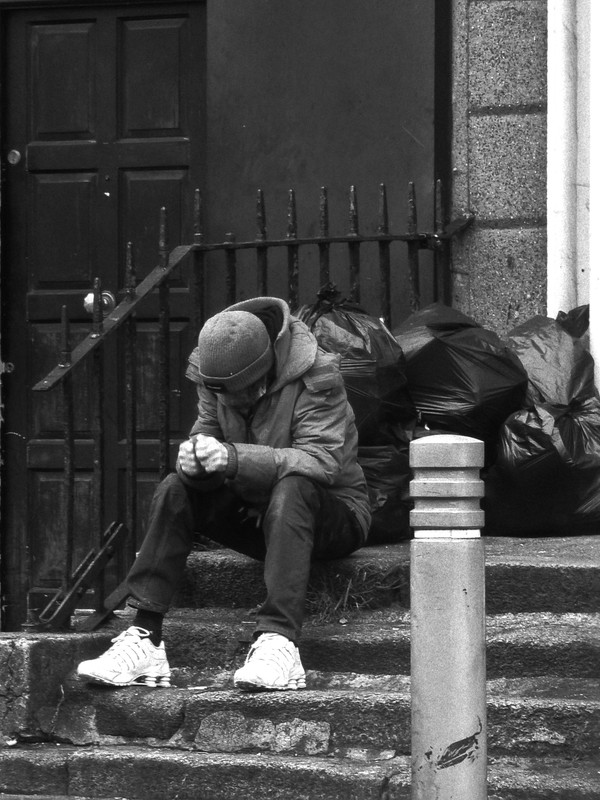
20211129_103905.jpg · Dorset Street & Blessington Street · the steps
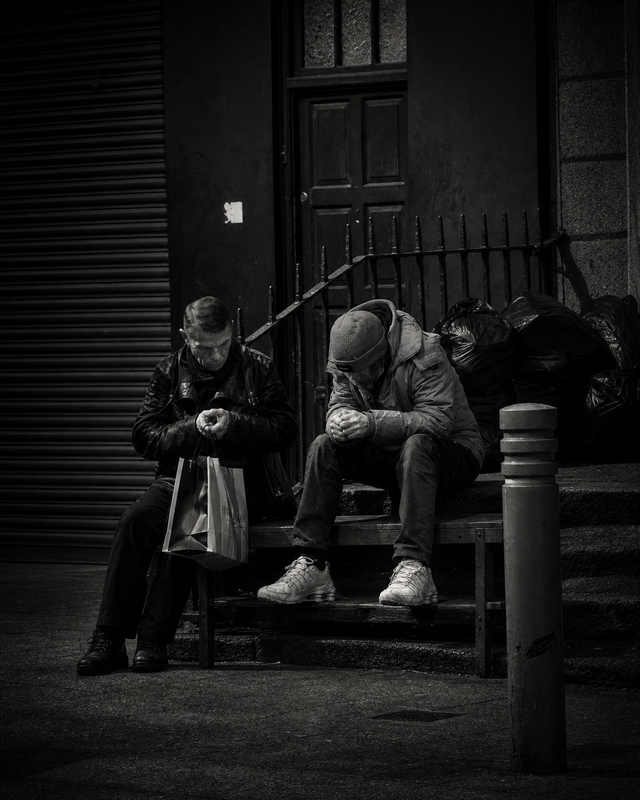
On the morning of 29 November 2021, I was driving along Dorset Street toward the college. Near the intersection of Dorset Street and Blessington Street, I saw a man.
He was sitting on the steps at a doorway. A blue jacket. A hunched figure. It was clear that he was suffering. And especially — his hands: they were trembling.
I don't know why it was him, specifically. The city is always full of people in difficult circumstances, and usually consciousness drives past without truly stopping. But something different happened here. I seemed to enter his condition from within — felt it not through thought but through the body: how heavy it was to sit there, in that morning city cold. His trembling hands became for me a point of contact, not simply a detail. This again was the same kinesthetic form of knowledge — not sympathy as idea, but sympathy as bodily event: another's trembling passed through me before I had time to think about it.
I photographed him. Two shots. Files with metadata recording the time: 20211129_103845.jpg and 20211129_103905.jpg.
That day I took no further photographs. These two shots became the sole photographic event of the day. I was not certain why I was making them. Simply — record it. Leave a trace.
I drove on. I did not know then that this place was already marked. That the next morning I would be here again.
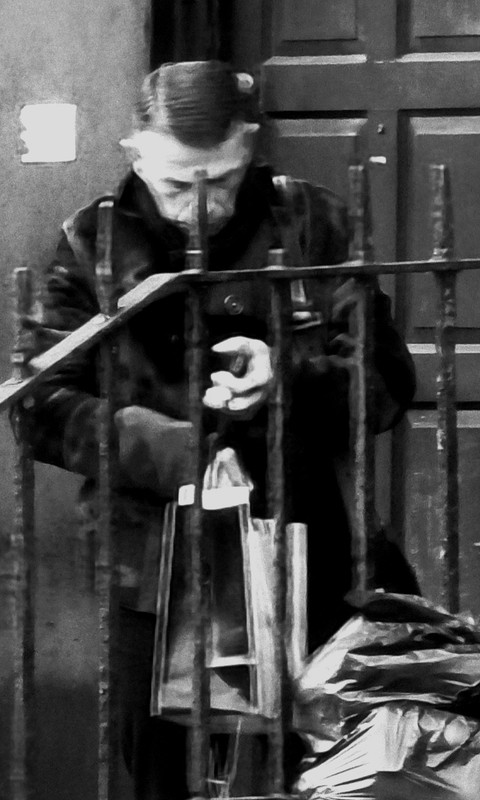
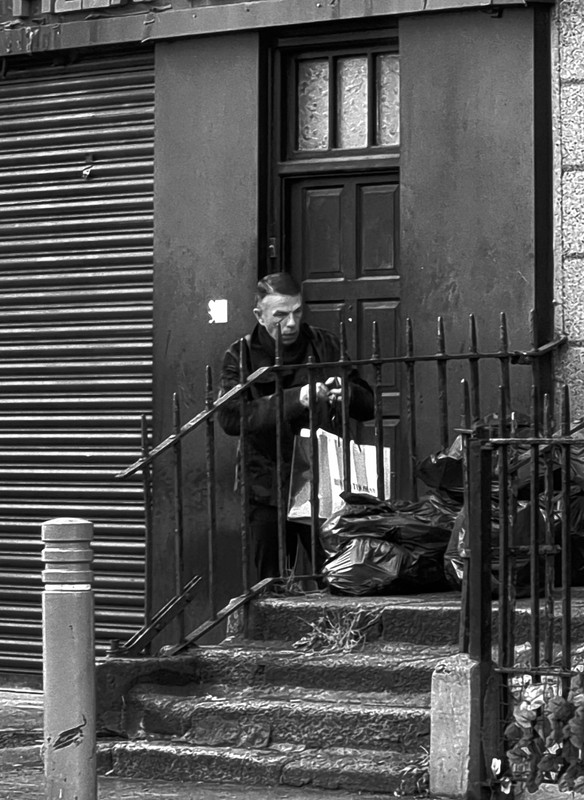
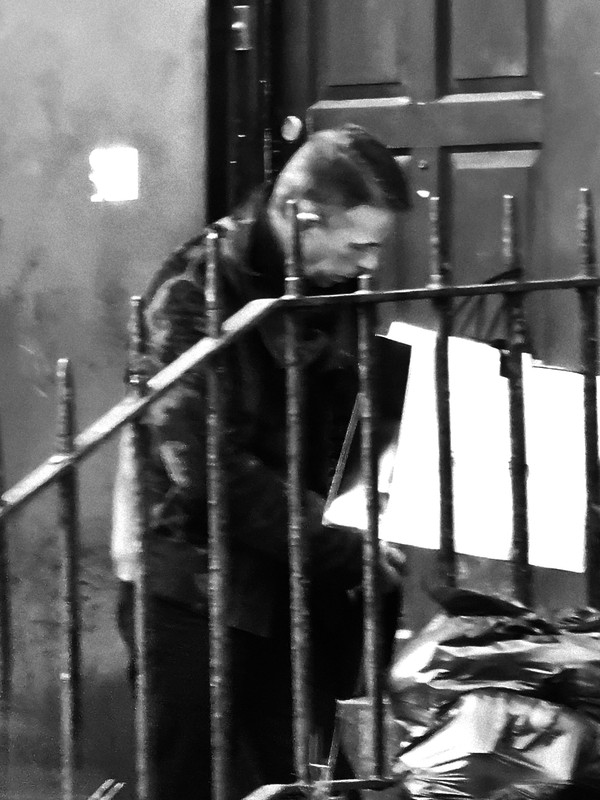
20211130_102513 · 102515 · 102521 · same location · fourteen minutes earlier
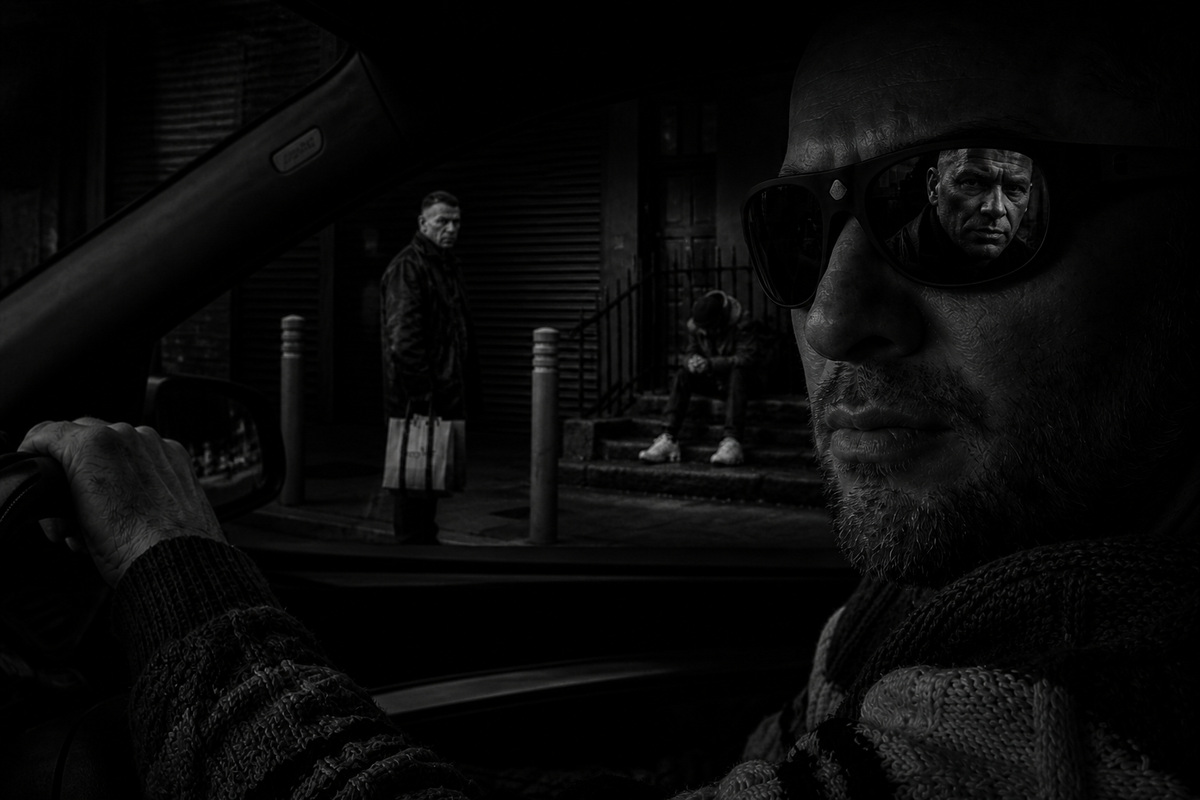
The following morning, 30 November 2021, around 10:25, I was driving along Dorset Street again. Fourteen minutes earlier than the day before.
In the same place where yesterday the man in the blue jacket had been sitting, I saw a man in a black jacket.
I recognised him immediately.
It was him. The client from the Riga boutique "Venezia." The man I had seen twice in Brown Thomas. The man I had pointed out to my daughter as someone from my past. But now — not in a shop. Not among branded clothing. On the street. In the exact spot where yesterday the man with the trembling hands had been sitting.
He was not walking down the street. He was standing in the corner of a doorway — pressed against the door, trapped between the railings of old steps. Beside him — a heap of black rubbish bags piled against the facade. In his hand, a white bag — the kind you carry out of expensive shops. He was moving, but not forward: back and forth, back and forth — as if searching for something, or as if something would not release him from this spot. A loop. Treading one point. Not a route — a suspension.
It was precisely this movement — not a face, not clothing — that gave him away. The same signature of presence I had memorised in Riga a quarter century ago: that particular way of existing in a space that does not coincide with where you are. In "Venezia" he did not coincide with the shop. Here — with the street. With the morning. With the movement of the city around him.
It was like a lag in a computer game: when the image continues to move but with a delay, a stuttering, when the world for a moment ceases to be smooth and reveals its underside. He looked like a character in whom something had briefly failed — as if reality had made a mistake it had not managed to conceal. Not illness, not fatigue, not ordinary strangeness. Precisely this sensation: a crack. Momentary, visible — and immediately closed.
Whitehead called this a "break through actuality" — a moment when the ordinary causal surface of reality becomes briefly transparent and reveals behind it something that does not fit within the usual mechanics of events. Not the supernatural. But the visibility of the lining. As if I saw what was not intended for ordinary eyes: a seam, a joint, a place where the structure of things briefly showed through.
Not fear. Not surprise. Something else, for which ordinary language has no ready word. It had the same quality as the Alpine dream — the same density, the same inner light, the same fear-that-is-not-fear. But the dream was a dream. This was Dorset Street, a grey November morning, a heap of black rubbish bags against someone's door, a man with a white shopping bag, suspended in the loop of his own movement.
The closest word is what Rudolf Otto called numinosum — but not as a concept. As a bodily fact. Simultaneously: relief and awe. As if something you have long not dared to name had named itself. The sensation of an enormous catch — not invented, not imagined, but caught: alive, real, heavy in the hands. "It exists" — not as conclusion, but as a blow from within. As if reality had just signed its name beneath what you had seen in a dream a month ago — and you stand there holding this signature, not knowing what to do with it.
At that moment something struck. Not metaphorically. I felt a wave of goosebumps. The hairs on my arms rose. I began to photograph — and noticed that my hands were trembling.
30 November, in the same place — mine did.
The trembling passed. Or returned. Or was one and the same state, stretched across two mornings and two different people.
I did not stop. Did not get out of the car. Did not approach him. I could have asked — did he live in Riga, had he ever been on Gertrudas and Baznīcas, did he know the boutique "Venezia." But the state was such that action had become impossible. When reality suddenly strikes you with meaning — it is not always possible to stop and speak. Sometimes one can only drive on.
Dorset Street & Blessington Street, Dublin
Two mornings. One point. Fourteen minutes between them.
Symbolic map · Dorset Street Lower × Blessington Street · Dublin 1 · Two mornings · One point
The Architecture of the Impossible: An Attempt at Calculation
I make no claim to mathematical rigour. But honesty demands an attempt.
There is a method called Fermi estimation: when precise data is unavailable, you build a calculation from approximations, marking uncertainty at each step. Physicists use it to assess the scale of phenomena that cannot be measured directly. I shall apply it to the structure of events on Dorset Street.
Nine conditions, each of which had to be fulfilled simultaneously. I will call them filters — because each eliminates the greater part of possible universes in which this event does not exist.
Filter Cascade · Fermi Estimation
One event per two trillion — location filters treated as one cluster, not independent. The other filters are not fully independent either: remembering him and recognising him by his behaviour are linked, and so are his living in Dublin and my meeting him in the same shop. The product is an order of magnitude, not a measurement; a careful conditional estimate would make the event less rare.
Even if every estimate is wrong by a factor of ten in every direction — raising the result by seven orders of magnitude — we remain in the zone of events that occur, at best, once in several generations. Not "rare." A different category.
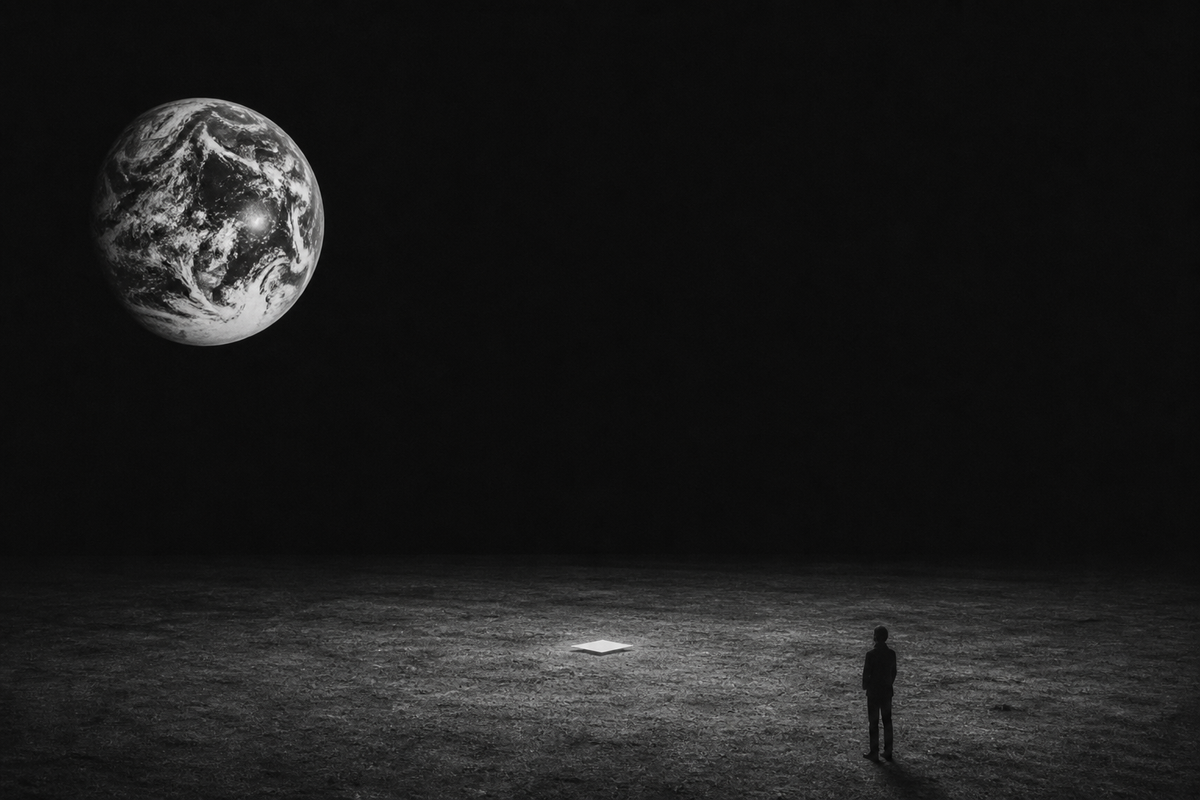
Cover the whole island of Ireland with a target. Drop a stone blindly from the sky. The probability of hitting one specific A4 sheet of paper lying somewhere on a lawn in suburban Dublin — is comparable to the probability of this event. The island of Ireland covers about 84,000 square kilometres: some 840 trillion square centimetres. An A4 sheet: about 620 cm². The ratio: about one to 1.4 trillion. Comparable order. (Spread over the whole surface of the Earth, 5.1 × 10¹⁸ cm², the same sheet would be one in about eight quadrillion — far rarer than this event.)
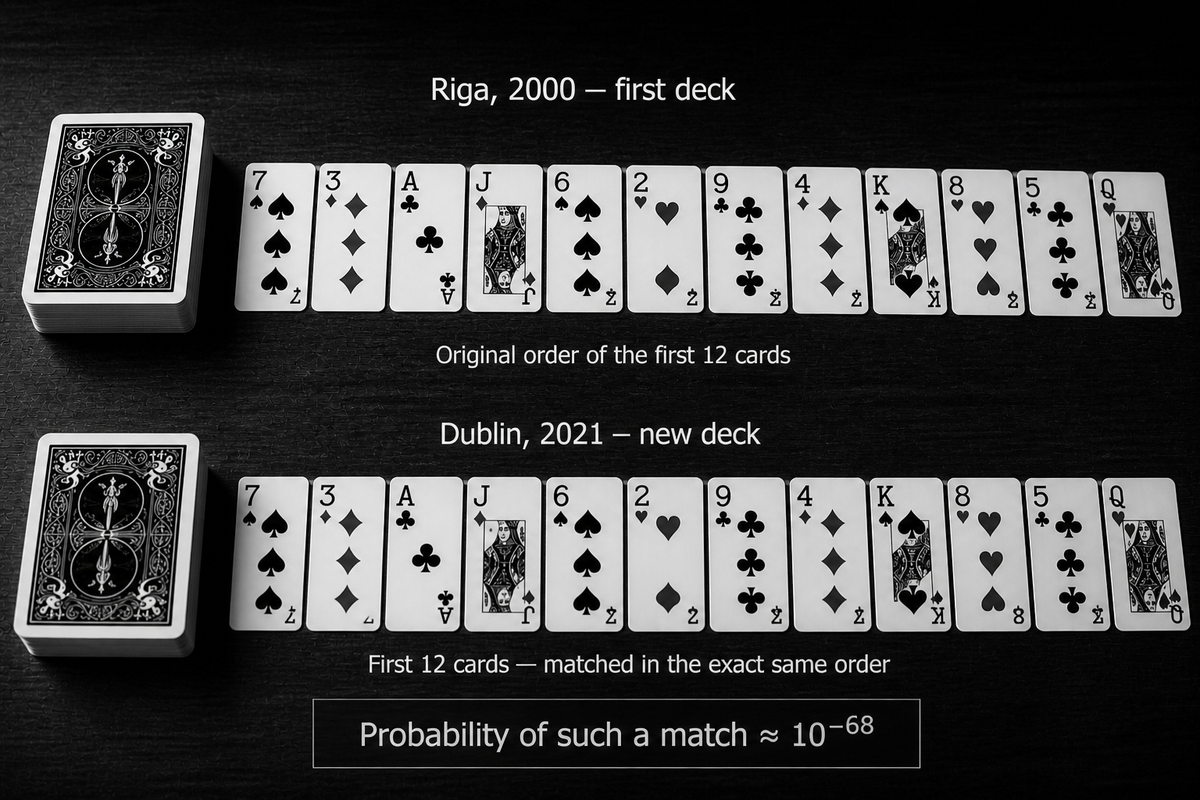
A deck was shuffled in Riga around 2000. In Dublin in 2021, a new deck was purchased and shuffled — and the first seven cards appeared in the same order: about one chance in 670 billion. Not "some" sequence. A repetition of the specific pattern across twenty years and 2,500 kilometres. Any sequence in a shuffled deck is unique — but its uniqueness means nothing. Here, uniqueness repeated. That is a different thing entirely.
When probability falls to this level, the rational apparatus registers an anomaly — and hands the floor to the philosophical. Not because mathematics capitulates. But because an anomaly of this magnitude requires not explanation, but a category. And that category is not "miracle" as violation of laws, but "miracle" as the exposure of a hidden law. A glitch in which the lining of how things are structured was, for a moment, visible.
This attempt to measure the event with mathematics is not a way of explaining it. It is a way of testing it to breaking point: to see whether it will crumble under the pressure of a number. It did not crumble. The number only showed how few instruments we have for working with what happened on Dorset Street in November 2021.
The Third Category of Causality
Causality as we know it says: A occurs — therefore B. This is Newtonian mechanics, extended into quantum physics and beyond. It works superbly for most events.
But there exist events that do not fit this schema. Not because they contradict physics. But because the connection between them is not causal but structural — two events arising from the same hidden pattern, without knowing of each other.
"Synchronicity as an Acausal Connecting Principle" — a third form of connection: not A causes B, but A and B are expressions of the same hidden structure.
The Nobel physicist who collaborated with Jung. Proposed a "psychophysically neutral" layer of reality beneath the separation of psyche and matter.
Pre-established harmony. Monads do not interact directly but run in parallel — like synchronised clocks set by one maker.
The "dialectical flash" — the moment when past and present suddenly form a constellation: not sequence, but simultaneity.
Riga, around 2000, and Dublin, 2021, were not sequential events on an axis of time. They became a constellation — an image in which both moments are present at once, without gap, as if the twenty years between them collapsed.
What I felt on Dorset Street was not "I remembered Riga." It was "Riga and Dublin became one." Two times — one point. This is what Benjamin called Jetztzeit — "now-time," in which history temporarily ceases to be the past and becomes a living presence.
Why the Third Meeting Was Different
The third encounter was qualitatively different — not simply another in a series.
The first two appearances in Brown Thomas could be held within the framework of explanation: he lives in Dublin, frequents the same shop, I happen to be there at the same time. Improbable, but possible. The rational mind manages.
But the third meeting occurred outside the space of clothing. On an open street. And not simply on a street — in the same point where the day before I had been struck by another's pain. Where I had stopped and photographed. Where something had compelled me to record.
This conjunction — the man from Riga, the man in the blue jacket, two mornings, one place, two sets of photographs with metadata — created the sensation that Rudolf Otto called numinosum: contact with something that exceeds the frame of the ordinary order of things. Not fear and not ecstasy. An acute, almost painful sense of meaning that exceeds the possibilities of its immediate explanation. The numinous does not console and does not threaten. It simply occurs — and after it, the world is differently structured.
There is another layer. On 29 November I entered the condition of an unknown person through his trembling hands — empathically, through the body. I observed — and simultaneously felt. On 30 November the trembling became mine. This is not simply a coincidence of symptoms. It is a transfer: from observer to the observed, from empathy to experience. As if on the first morning I opened a bodily channel — and on the second morning, through it passed what had to pass.
Here it is necessary to say exactly what the identification rests on. It began in the body: kinesthetic memory, the same slowness, the same way of holding space, more than twenty years later. On its own that would be subjective testimony. But it does not stand alone. Both mornings are photographed, and the file times place two different men on the same spot on two consecutive days. And a former colleague from the Venezia boutique, who saw the same man there in those years, looked at the photograph of 30 November and recognised him. The identification is not mine alone: it is confirmed by a second witness who knew him in Riga. This is a documented meeting — not a mystification, and not a reconstruction after the fact.
And the structure of what was experienced stands on that record. The meeting is confirmed — and the event occurred. The trembling hands of the first morning and of the second are documented. The location is documented. The fourteen minutes are documented. The recognition is documented twice: in this text, and by the colleague who identified him from the photograph. The event happened in me with a degree of reality that did not disappear after.
The Dream Opens the Threshold. Dorset Street Seals It.
I have already written about the Alpine dream of 2021 — the hidden door, two elders, the raised left hand. About how after it the space changed. How a sense of a second layer of reality appeared. How I woke no longer quite in the former world.
This happened one month before the November events.
The dream opened the threshold. Dorset Street placed a seal upon it.
After the dream I could still doubt: perhaps it was a psychological state, fatigue, the influence of studying, heightened sensitivity. The event of 30 November 2021 made doubt significantly harder. Because it had files. Because it had metadata. Because it occurred in a sequence — two mornings, one place, two tremblings — that does not yield to simple explanation.
If the dream was an internal transition — the encounter on Dorset Street became its external confirmation. The world answered not in words. It answered through the structure of an event: through person, place, time, repetition, and trembling. Through the body as organ of perception. Through photography as a form of archival memory.
Later came Jung, Steiner, Jaspers, Arendt, Tolstoy, Böhme, Pauli, Rothko. The concept of synchronicity arrived — not as metaphor, but as category of experience with its own philosophical and scientific history. The project I call Spirit of Time arrived. Gradually it became visible that the November event was one of the early points on a thread — that thread which Jung described as visible only in retrospect: in the moment of movement, only darkness.
And something else came later: the understanding that probabilistic calculation and philosophical analysis are not attempts to explain the event and thereby neutralise it. They are attempts to be an honest witness. A person who has lived through something like this stands before two traps: to say "it was a miracle" — and thereby leave the verifiable; or to say "it was coincidence" — and thereby lie to oneself. The third path is precise language and an open horizon. I do not know what it was. I know how it occurred. And I know that with such structural rarity, it could not but change me.
Without theory. Without explanation.
Like a person standing in a dark room, waiting for their eyes to adjust.
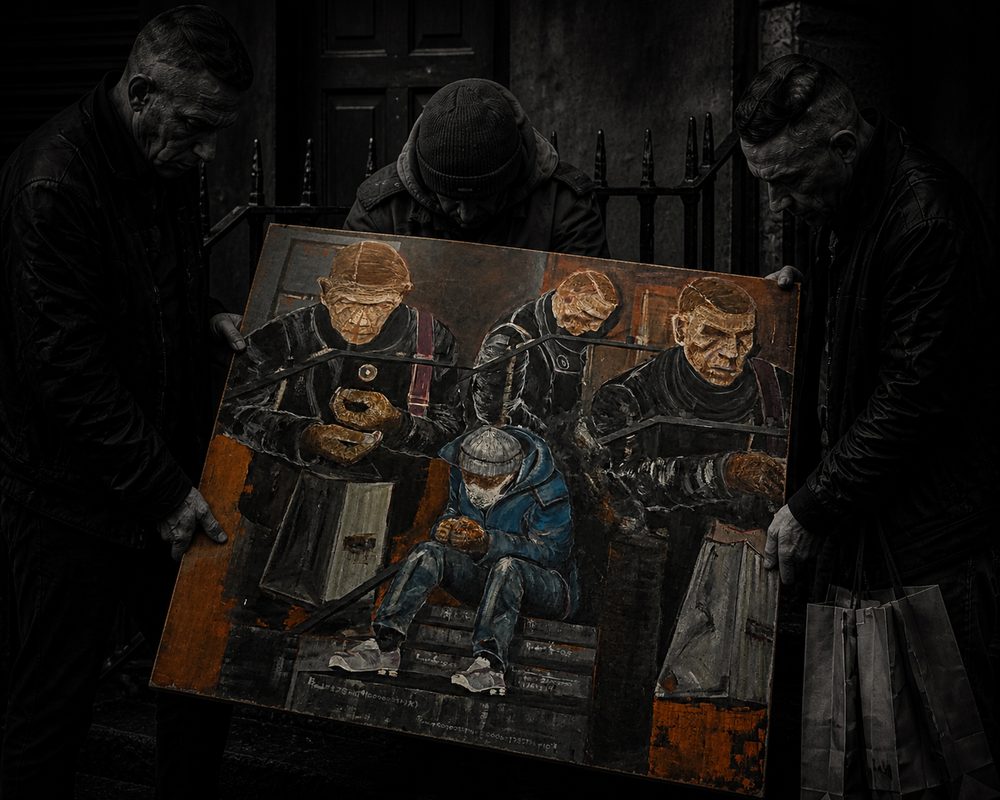
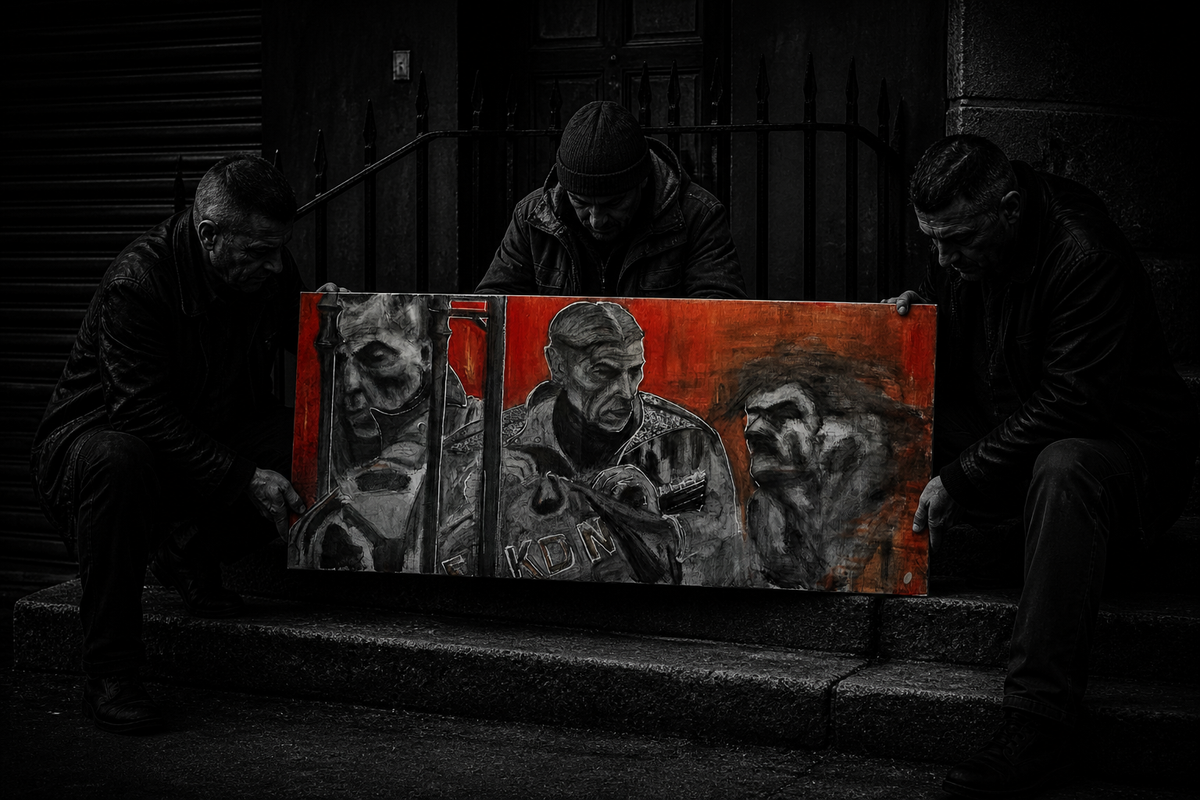
Works in Oil & Charcoal
Paintings made in the same period — the same hands, the same search.
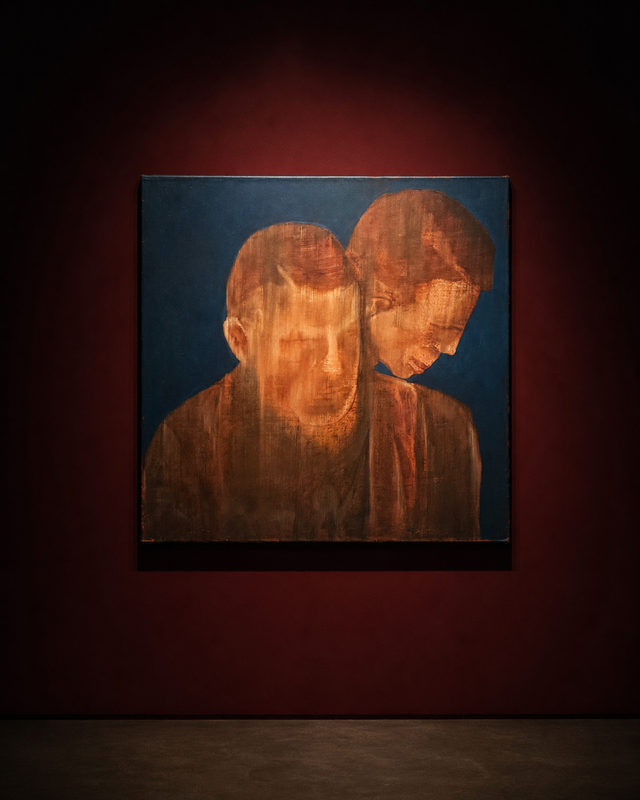
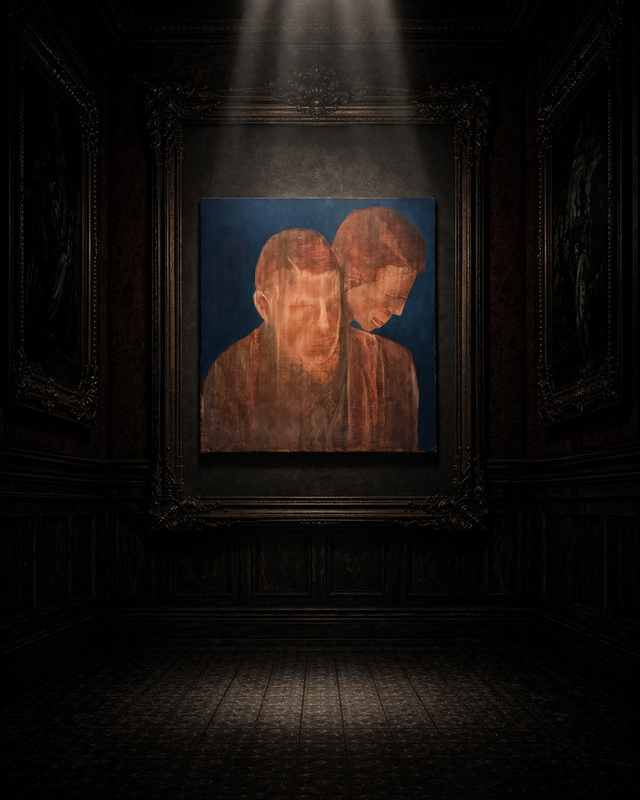
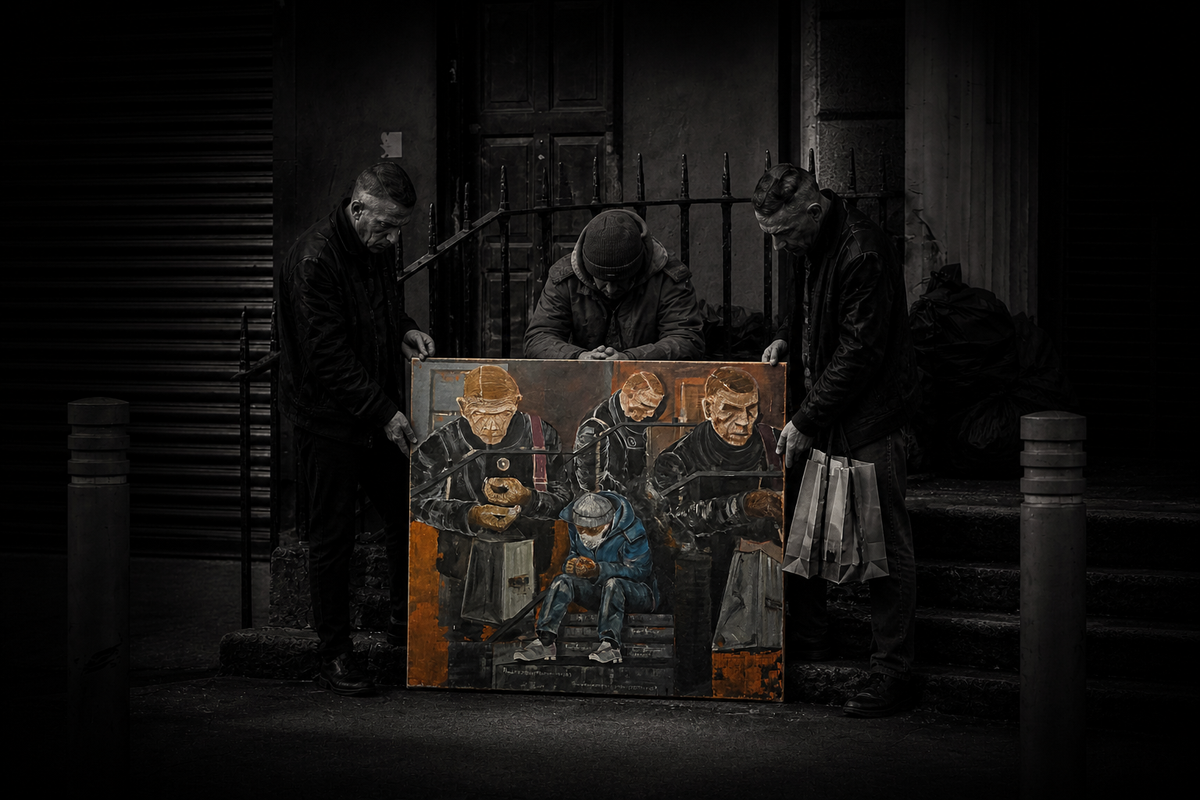
I have been working on this painting for four years. It changes constantly — repainted, covered, reopened. I cannot catch the subject. Something keeps slipping from my hands. Each time I think I have it, it moves. Perhaps that is the subject.