8 May
NOISE FACTORY
On how the memory of war was turned into a mechanism for producing war
I heard my grandfather before I saw him.
The creak of the prosthesis. Plastic and wood, slightly hoarse, with every step. He had not yet appeared in the yard, and still the sound was already drawing closer.
As a child I saw nothing tragic in that sound. The creak of the plastic-and-wood prosthesis was as much a part of the house as the smell of bread or the evening light on the wall. Only years later did memory slowly unfold what had been hidden then: in that faintly hoarse, repeating creak, not only a man was moving, but the war itself — never fully gone from his body.
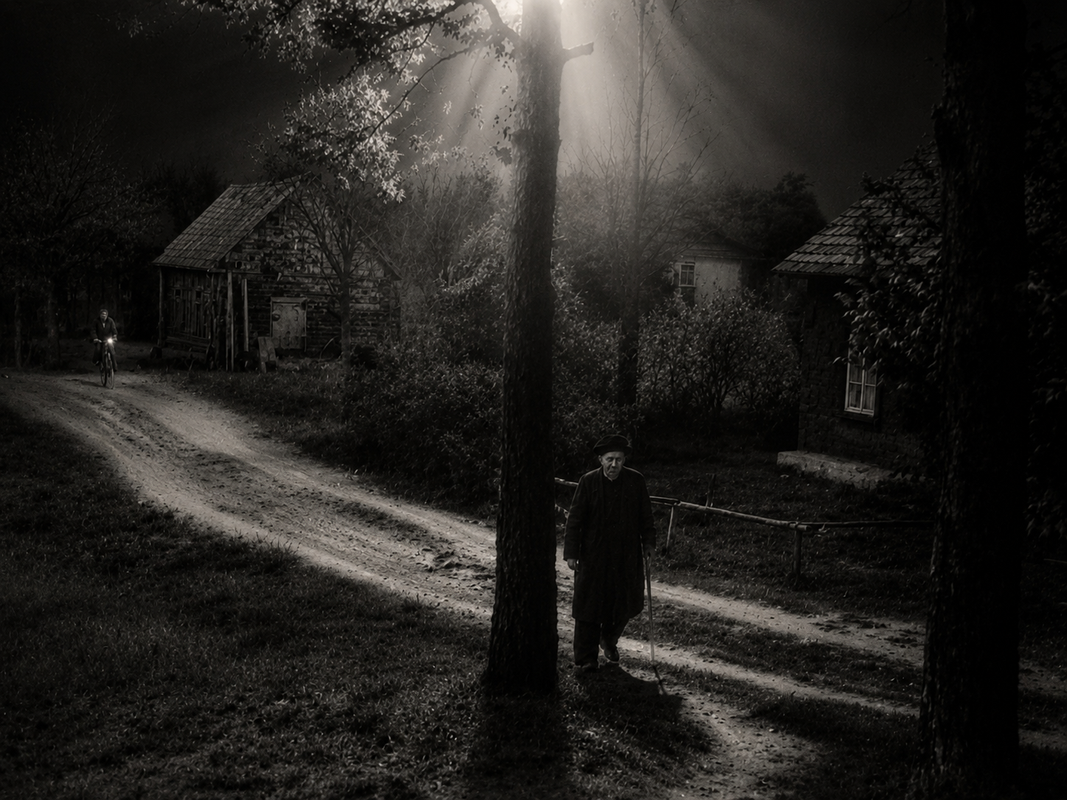
I was a child, and that creak belonged to Latgale the way roosters belong before sunrise, the way the smell of a wet barn belongs in the mornings, the way heavy rain belongs on old slate, the way a bucket belongs by the well, the way the cool half-dark of the church belongs — where my grandmother took me to mass, where she sang in the choir. They would seat me beneath the organ. And I remember that waiting: the organ still silent, people settling, murmuring, the smell of incense, wet coats and old stone, and then suddenly beneath the vaults a sound would begin to rise. Not outward — inward. Into the candlesmoke, into the coolness of the walls, into a child's sense of something enormous, before which you are very small.
Sometimes we had to kneel for a long time. The knees hurt — genuinely, almost unbearably, because I was growing and the body resisted that stillness. But I held on. I do not remember the words of the mass. I remember that pain, the coolness of the church in summer, and the moment when the organ began to sound.
In a creak. In a smell. In the pain of knees on cold wood. In a gesture. In silence.
That is why my grandfather's war stayed not in stories — but in the plastic and wood of the prosthesis, in the effort of lifting the leg into the boat, in the stack of worn prostheses in the attic. In the sound that preceded him across the yard every morning.
I did not know then that sound could be a document.
That a creak is also a text. That it holds more than any official narrative of war.
Today is 8 May. Europe marks the day of victory over Nazism — quietly, without parades, with a minute of silence, with downcast eyes. And today, in this quiet, I hear it again. Not because I chose to remember. Memory does not ask permission. It arrives like a smell — suddenly, without warning — and time collapses. Latgale of the seventies enters today through a sound that has long since ceased to exist.
The creak of the prosthesis.
And I am back there.
Bronislavs Silvestrovičs Drukalskis. Teacher. Latgalian with Polish roots. A man who played all instruments — wind, string, bowed — and kept his orchestra of village schoolchildren. A man who lived in Aglona. He did not travel there — he lived there. The Basilica of Aglona was not a pilgrimage. It was the air he breathed every day. Part of the horizon.
And a man with one leg.
Every evening — I saw it so many times it became part of the bodily landscape of childhood, like sunset, like supper, like the smell of bread — he would sit on the edge of the bed and remove the prosthesis. Slowly. Without words. Plastic and wood. Not a ceremony and not a tragedy. Simply work. Daily, habitual, unavoidable. The prosthesis was laid beside the bed — like a part of the body that could be set aside until morning. Then he turned out the light.
In the morning he put it on again.
In that gesture — put on the prosthesis, stand, walk — there was something that is never spoken of in war speeches. Not heroism. Not sacrifice. Simply the continuation of life in spite of what the war had done to the body. Day after day. Year after year. Without pathos. Without expectation of gratitude.
In the attic lay the prostheses.
Not one — all of them. His whole life. Each one that wore out was replaced and removed — not thrown away, but set aside. They accumulated there, each slightly modified — a different fastening, a different ratio of plastic to wood, another attempt to make the impossible a little more possible. Different years, the same function.
I remember that attic. How they lay there — dark, worn, silent. Each was a cast of a particular year of his life. Each carried the imprint of the body — where the remaining limb had pressed against the plastic and wood thousands of times.
Not a museum. Not a monument. Just an attic in a Latgalian house.
The state builds monuments. Erects obelisks. Casts bronze.
And the war lay in the attic — worn out, dusty, without a plaque. Only the trace of a body that had continued to live in spite of everything.
This war was not his war. He lived in Latvia. History came to him — he did not go to it. Large forces moved across the map, and his body was in the way. The war chose him — he did not choose war. It took his leg, left him his life, and moved on, without asking whether he agreed to become part of someone's narrative of victory.
He was not the hero of another's story.
He was a man whom history physically broke and left to live on.
Because a hero can be used. Placed on a pedestal, written into a parade, turned into a symbol. But a man who was simply broken and left — cannot. He has no pose for a monument. He has only the creak of plastic and wood in the mornings.
And the attic with those that wore out.
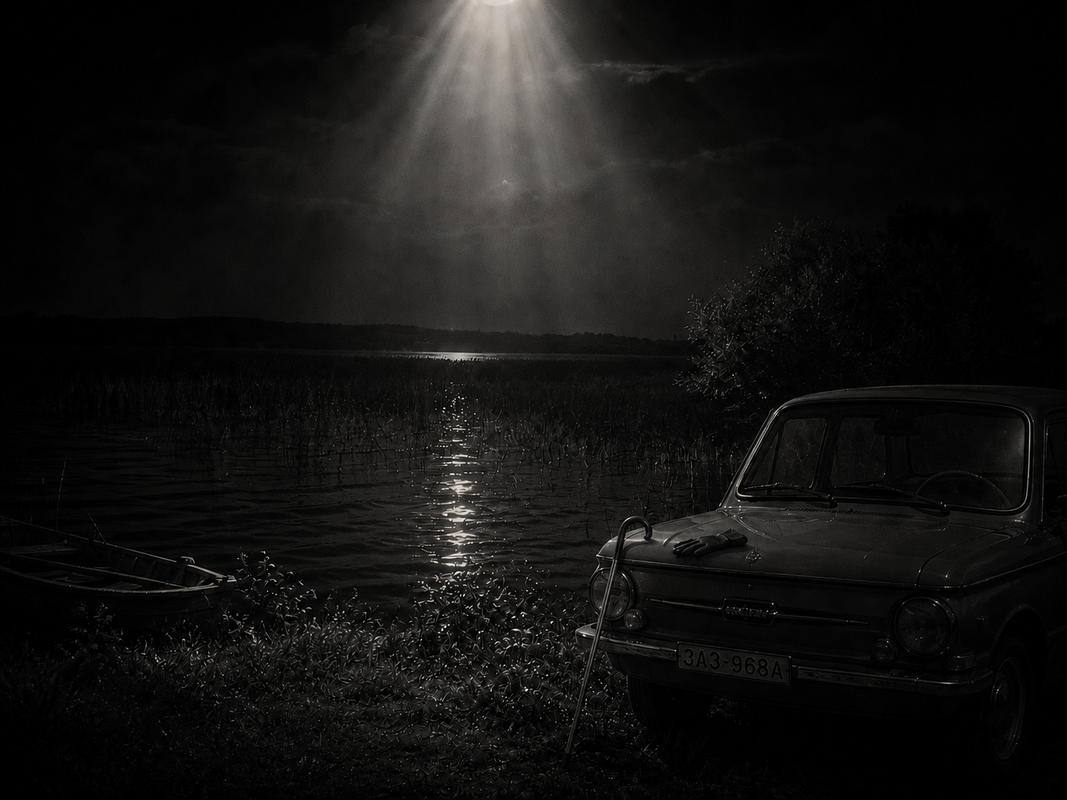
He had a Zaporozhets.
First an old invalid's model. Then the Zaz-30. Then — through a veteran's disability subsidy — the Zaz-40. The state gave not out of generosity. The state gave a bone.
The gas was on the handle. A car for a man with one leg. He repaired it himself — in the garage, in the village. More time repairing than driving. With the same hands that held the bow. That taught children to read music.
There was almost no meat in the house. They kept a piglet. Chickens. A kitchen garden. He made wine — homemade, Latgalian. The state that had proclaimed itself the victor over Fascism fed its veterans on scraps. A ration card for meat that did not exist. A subsidy for a car you repaired yourself.
In wooden houses with kitchen gardens, with plastic-and-wood prostheses beside the bed and attics where all the previous ones lay — like a chronicle of a body that had survived what better had not happened.
Those who today build temples of war and hold parades — they did not grow from this. They grew from the myth of this. The myth is beautiful, monumental, fit for use. The reality lies in the attic and smells of dust and leather and old plastic.
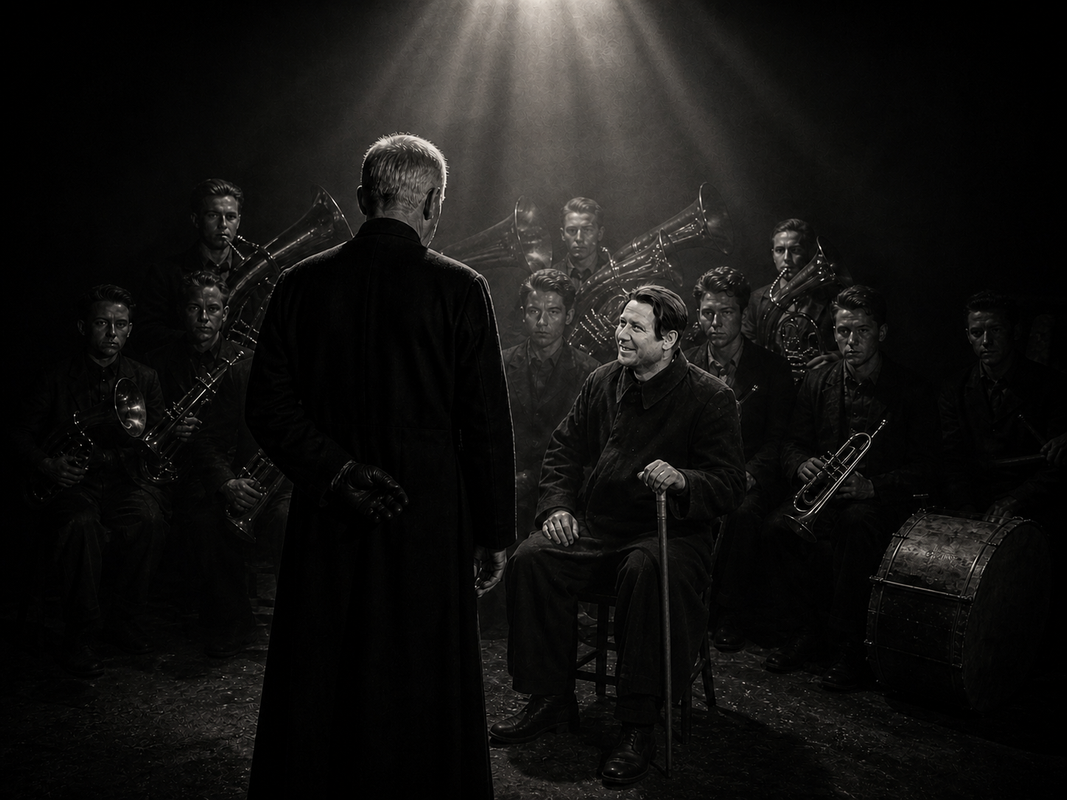
Once a year, in August — on the fourteenth and fifteenth, on the Feast of the Assumption of the Blessed Virgin Mary — a friend came to visit my grandfather.
Not on 9 May. Not for a state holiday.
In August. To Aglona. To the basilica.
They had passed through the war together. One came back a teacher. The other became a priest.
I remember him clearly. Around his neck — a camera. He photographed. He would press the camera against his body with the prosthesis, and with the other hand slowly wind the film for the next frame. In this there was a tension — not theatrical, not heroic, but habitual, bodily. The war had taken the hand, but had not taken the gaze. He still looked at the world and wanted to hold it.
And they walked together across the Latgalian land — the teacher without a leg and the priest with the camera around his neck — to the basilica that had stood beside my grandfather's house all his life. White, above the lake, in the August light.
Not to celebrate victory.
To be silent before something greater than any state.
Once a year they met in August, and this silence was denser than any speech.
Not a flag. Not a march. Not a symbol on a car.
A glove. A camera. The creak of plastic and wood. An attic. August. A white basilica above a lake.
The grandfather left me that Zaporozhets as an inheritance.
I was fourteen years old. I sold it without driving it.
I did not understand then what I was selling. I did not understand that in the metal of that car — in the gas handle, polished by his palm — something was written that cannot be bought back.
But he left me more than a car.
He left me a house. And memory.
A house in Aglona that smelled of wood and old wax and something else for which there is no name. The memory of the attic with the prostheses, of the boat at the school beach, of the creak that preceded a man across the yard every morning. The image of a man who pressed a camera against his body with a prosthesis and slowly wound the film — because the world is still worth holding.
This is the inheritance. Not what can be sold.
What stays in the body. And in memory.
He survived by chance. In the forest, after a bombing, soldiers passed by — they took him for dead. They were wrong.
And he never made a legend of it.
He never spoke of the war. At all.
They simply live with it — in the body, in the creak, in the prosthesis beside the bed, in those that lie in the attic.
Understanding comes later.
If it comes at all.
Today is 8 May.
Europe remembers. Quietly. With lowered heads.
Tomorrow is 9 May. Russia will celebrate. Loudly. With military hardware on Red Square, with children in military caps, with Z on their chests, with speeches about eternal victory and eternal enemies.
These two days are not simply different dates. They are two different answers to one question: what to do with the memory of catastrophe.
The first: remember. Mourn. Do not repeat.
The second: use. Mobilise. Repeat.
9 May was not always what it has become. Those who survived the war did not celebrate it. They remembered — bodily, quietly, in the dark. The mass state cult of Victory began forming under Brezhnev, from 1965. The living wound began to turn into a monument.
A monument does not hurt.
A monument can be managed.
The 'Immortal Regiment' began as a living gesture — people carrying portraits of their dead. Personal. Painful. Then the state appropriated the movement — and the portraits of the dead began marching in the state column. The dead stopped belonging to families. They became a function.
The portrait of Bronislavs Silvestrovičs — the man who kept all his prostheses in his attic, the entire bodily archive of the years lived after the war — could have ended up in that column. Marching. Turned into a symbol of what he had been silent about his whole life.
The dead cannot object.
That is the chief convenience of the dead for the state.
It is written about this thus: a totalitarian system begins not with camps — but with language. With the replacement of a specific human being with an abstract function. Where a person ceases to be a unique fate and becomes a soldier, a hero, a people, a mass, an immortal regiment — there, not only is his freedom taken away. His biography is taken away.
Bronislavs Silvestrovičs is not a 'veteran'. He is the man whose creak of a plastic-and-wood prosthesis I heard from a distance. Who played the violin and taught children to hear music. Who in August walked to the basilica beside a friend — the one who pressed a camera against his body with a prosthesis and slowly wound the film. In whose attic lay all his prostheses — a silent archive of a body that had survived what it should not have survived.
That is what war is.
Not a parade. Not a banner. Not 'we can do it again'.
A creak. A camera. An attic. August. Silence at the white basilica above the lake.
When the state takes this specificity and turns it into a collective symbol — it commits violence against memory. It destroys personal connections and replaces them with a connection to the mass, to the state, to the myth.
From wound — to costume.
From the attic with the prostheses — to a bronze monument.
It is thought about thus: those who shout loudest about war — never woke at night to the sounds of a person whose remaining limb aches and will not let them sleep.
They do not know that sound.
Not the creak — that is a daytime sound, almost habitual. But the nocturnal one — when the body speaks truth without witnesses. When the remaining flesh aches for the one that is no longer there. When a person who has survived the war lies in the dark — and the war continues in them quietly, methodically, without end.
They have not heard this.
They have not climbed to such an attic.
They inherit not the wound.
They inherit the myth.
When the real experience disappears, the ideological form remains. It begins to live by itself — form without content, symbol without body, parade without pain.
Catastrophe becomes beautiful.
War turns into an aesthetic object — a parade, a ribbon, a temple of war, a child's uniform, a march, Z as a graphic sign. This is no longer memory. This is the state's visual religion. And this is more frightening than any open cruelty — because beauty disarms, and a disarmed person stops asking questions.
A child in a military cap does not analyse history.
He experiences belonging.
He learns to see war not as what lies in the attic in the form of worn prostheses — but as a scene of power, beauty, pride.
The country that speaks loudest of traditional values — of family, of faith, of dignity — simultaneously and methodically destroys the only condition under which dignity is possible at all.
Dignity is impossible without inner freedom.
Without freedom of conscience. Without freedom of speech. Without the right to inner dissent. Without the right not to participate in collective ecstasy.
The system demands not conscience.
It demands belonging.
Not inner truth — but participation in ritual.
A person cannot entirely hide behind 'we'. Behind the people. Behind the holiday. Behind history. In the moment when he dissolves into the collective 'we' — he ceases to be accountable for himself. And that is precisely when everything becomes possible.
My grandfather never dissolved in 'we'.
He was a specific person. With a specific plastic-and-wood prosthesis. With a specific boat. With a specific attic. He walked to a specific basilica with a specific friend — the one who pressed a camera against his body with a prosthesis and looked at the world through the lens. He was silent with a specific silence.
Not the kind spoken of from platforms.
The kind that lives in the body and needs no words.
From February 2022 it became visible what this culture of memory turns into in action.
Russia began its war against Ukraine under the rhetoric of fighting Nazism. The victory over fascism — real, paid for with real bodies, including the body of Bronislavs Silvestrovičs — was used as moral capital to justify aggression, the destruction of cities, the killing of civilians.
The system speaks the language of anti-fascism.
And reproduces its mechanisms.
Totalitarianism knows how to speak any language. Including the language of its own victim. What matters is not what words are spoken. What matters is — what happens to the person inside the system.
What happens is this: the attic is taken from him.
The right to a personal, quiet, bodily, inconvenient memory is taken away. In its place: a flag, a ribbon, a military cap, collective excitement.
And the prostheses in the attic — gather dust.
No one speaks of them.
Because they are inconvenient. Because they are not beautiful. Because they are the truth.
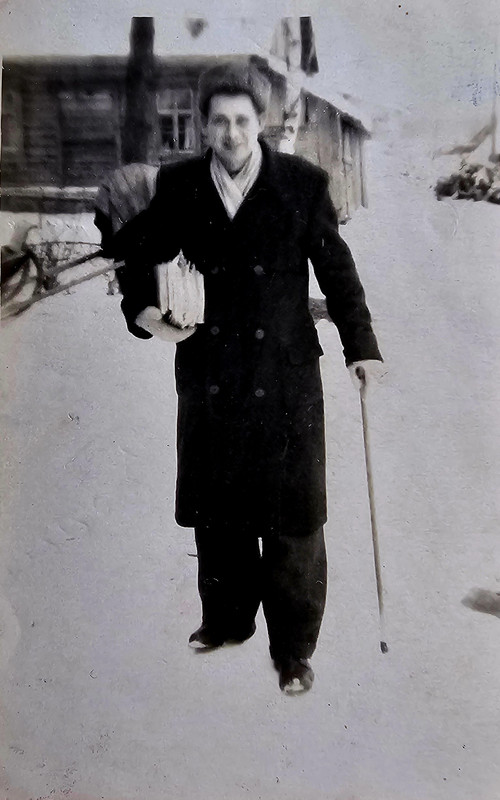
Where a minute of silence should have been, the state built a noise factory.
I think about the attic.
About how they lay there — all those prostheses, one after another, for every year lived. Worn. Dark from time and from skin. Plastic and wood. Slightly modified each time. They were not thrown away. They simply lay — as things lie that have no name, that one does not know where to put, but cannot give away.
Not in bronze. Not in a square.
In the attic. Of plastic and wood and time.
He left me no speeches about war.
He left me a house. And memory. An attic with prostheses. A creak I heard from a distance. The August light over Aglona and the image of two people walking across the Latgalian land toward the white basilica above the lake. The image of a man who pressed a camera against his body with a prosthesis and slowly wound the film — because the world is still worth holding.
This is the inheritance. Not what can be sold.
What stays in the body. And in memory.
War is frightening not when it is remembered.
It is frightening when it begins to be beautifully arranged by people who have never woken at night to the sounds of a remaining limb. Who have never climbed to such an attic. Who have never seen a man press a camera against his body with a prosthesis and wind the film — because the world is still worth holding.
Memory stays not in events.
In the body's sensations.
In a creak. In the pain of knees on cold wood. In the smell of incense. In the sound of the organ under the vaults. In the plastic and wood of a prosthesis put on each morning, because life continues.
One specific person.
Bronislavs Silvestrovičs.
Who was silent.