Reading Hannah Arendt:
How Nazism Is Born
and Why This Beast Did Not Disappear
Reading Hannah Arendt matters not only as a return to history, but as an attempt to see the very mechanism by which evil is born. Not individual episodes, not a set of familiar words about dictatorship, not ready-made moral formulas — but the structure itself.
The Main Thesis: When Evil Becomes the Environment
It is important to understand how Nazism arose, how it assembled itself piece by piece, how it transformed from an atmosphere of humiliation, fear, revanchism and hatred into a political machine, and then into a machine of annihilation. It is equally important to understand something else: it did not disappear without trace along with the Third Reich. It does not live only in archives, photographs and documentary footage. Its elements continue to be present in the air of history, in language, in mass psychology, in the temptation to find the guilty party, in the thirst for purification through exclusion, in the readiness to dissolve personal responsibility into collective impulse. To see this beast, one must look at it from above, stage by stage, as a system.
Where Nazism Grew From
Nazism did not arise from nowhere. It grew from several streams at once. Germany's defeat in the First World War, the Versailles humiliation, economic collapse, inflation, unemployment, fear of communism, longing for order and greatness, the old forms of European antisemitism — all of this became the breeding ground. But the environment alone does not give birth to the monster. For that, a further step is required: the conversion of anxiety into myth.
The people begins to think of itself as an insulted whole that must reclaim its strength. History is reduced to the image of loss and impending restoration. Against this backdrop appears the idea of the internal enemy — one who allegedly corrupts the nation from within.
Antisemitism Changes Its Nature
Here antisemitism changes its nature. Earlier antisemitism was often a social, religious or everyday prejudice. With the Nazis it becomes racial metaphysics. The Jew ceases to be a neighbour, a colleague, a dissident or a foreigner. He becomes the symbolic figure of absolute threat — the container of all projections, the bearer of everything the society refuses to recognise in itself.
Weakness, crisis, defeat, cosmopolitanism, decadence, revolution, financial power, moral dissolution — all of this is projected onto him. Thus arises not simply hatred of a group, but a pseudo-sacral image of the enemy, through whose destruction the healing of the world is promised.
Myth Becomes State Form
The next and decisive stage is the conversion of myth into state form. The party seizes not only the government, but the very fabric of society. Independent parties, trade unions, autonomous organisations, a free press, cultural and educational spaces are all destroyed. Total coordination arises. Society ceases to be a multiplicity of independent spheres and becomes a single channel through which one will flows. This is the moment when Nazism ceases to be merely a movement and becomes an order.
Unity through Exclusion
Together with this, the myth of national unity is constructed. But this unity has nothing to do with the common good. It exists only through exclusion. The national body is declared organic, pure, integral — and all those who do not fit this model turn out to be disease, contamination, threat. Unity is achieved not through the reconciliation of differences but through the expulsion of the different.
Legal Alchemy: The Stripping of Rights
After this begins the legal alchemy. A person is stripped not only of dignity but of status. First comes the legal restriction, then exclusion from professions, public life, property, civic rights. Then the racial principle is enshrined, declaring some fully human and others biologically alien. At this stage, annihilation does not yet necessarily look like murder. It begins as a change in the gaze itself. The person ceases to see a personality and begins to see a category. Law becomes an instrument of dehumanisation.
Propaganda as the Normalisation of the Monstrous
Propaganda does not play the role of simple lying here. This is a deeper process. It restructures the very reality of perception. Mass marches, symbolism, slogans, school curricula, cinema, radio, culture, the press — all of this creates a world in which Nazism looks natural, and resistance to it appears artificial, suspicious or even abnormal. Propaganda does not merely persuade. It normalises. It makes the monstrous habitual.
The Organisation of Guilt: Secret, Rumour, Open Knowledge
One of the most terrible features of this system consists in the fact that crime is first concealed, then spreads as a rumour, and then begins to be spoken of almost openly. Secrecy is needed in the early stage. Rumour is needed as psychological preparation. Open knowledge is needed for drawing people into complicity. When many people know but are silent, what arises is no longer simply fear but a network of shared contamination. The person is now bound to the system not only by action but by knowledge.
The Erasure of Distinction
This is precisely what Arendt saw with particular clarity: Nazism strives to destroy the distinction between the active criminal, the career opportunist, the silent observer and the person who inwardly disagrees but outwardly submits. This does not mean there were no distinctions. It means the system worked toward their erasure. If everyone is involved, if everyone knows something, if everyone is frightened, if everyone is bound by a common atmosphere — then after the fall of the regime it becomes difficult to distinguish the fanatic from the executioner, the coward from the victim, the silent opponent from the silent accomplice.
The SS, the Gestapo, the Camps: the Expansion of Participation
This is why the SS, the Gestapo, the camps and the army take on such special significance. Initially evil is concentrated in special apparatuses. There exist dedicated structures on which direct terror is imposed. But as the regime radicalises, the circle of executors expands. Violence ceases to be the monopoly of a small elite and begins to draw in ordinary state institutions. The comfortable illusion disappears — the illusion that crimes are committed only by special monsters while everyone else stands apart. No, the machine is constructed differently. It expands the zone of participation.
The Concentration Camp as Laboratory of Routine Horror
The concentration camp becomes not only a place of isolation but a laboratory of the new norm. There the exceptional is translated into routine. Inhumanity becomes the order of the day. This is one of the key mechanisms of all of Nazism: the impossible becomes everyday, and therefore ceases to be experienced as something that lies beyond the boundaries of the world.
War as Radicaliser
It is particularly important to understand that war does not merely accompany this system — it radicalises it. War provides the space for the expansion of exclusion and the acceleration of annihilation. It serves as the justification for emergency, mobilisation, discipline, suspicion and mass violence. On the external front a battle is fought, but on the internal front a far more subtle operation proceeds: the fusion of society with crime.
The heavier the defeats become, the more powerfully the regime strives to implicate everyone, so that after its collapse no clean space remains from which a new beginning might emerge. Military defeat could signify for the Nazis a political victory of another kind, if they succeeded in binding the people to themselves through shared guilt, shared knowledge and shared silence. Falling, the regime seeks to draw everyone into the fall. As if to say: if we go down, we go down together. Thus the collective becomes not only an object of mobilisation but a hostage to what has already been done.
Collective Responsibility and Individual Guilt
Here arises the most difficult knot of the entire theme: collective responsibility and individual guilt. Politically, a society may be responsible for what it permitted, supported, justified or failed to stop. But individual guilt does not dissolve into the collective and is not automatically equalised for everyone. This is one of the most important and most uncomfortable truths.
If everyone is declared equally guilty, real distinction again disappears. But if responsibility is completely removed from the society, then the very ground on which all this could grow disappears. Nazism uses precisely this confusion — and benefits from it both before and after its fall.
The Destruction of Truth Itself
Another terrible mechanism consists in the destruction of the very possibility of judging reality. When executioners receive the necessary documents, when victims disappear, when witnesses are destroyed or scattered, when the language of camps and terror is concealed behind euphemisms, when lies become the official form of describing the world — then not only life collapses but the criteria of truth.
The Anatomy of Nazism: A Staged Structure
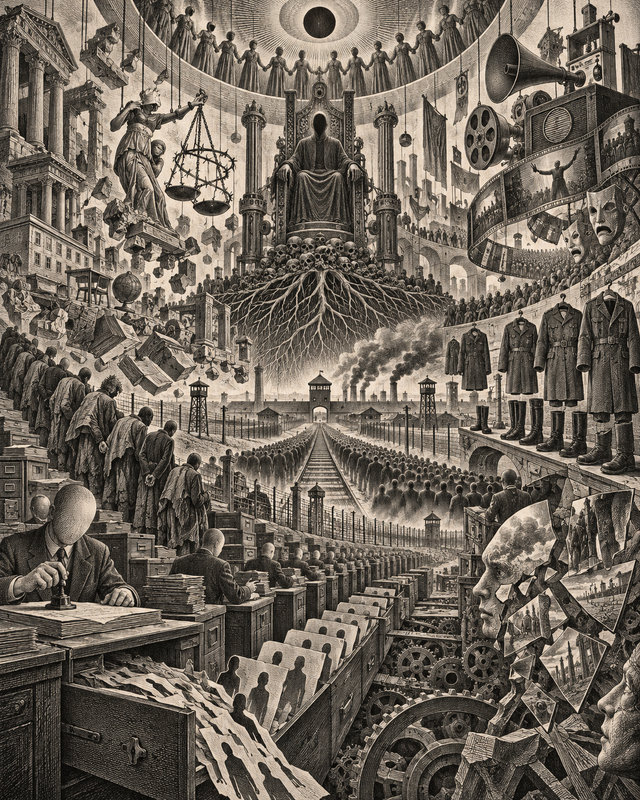
Viewed from above, the structure of Nazism takes shape in stages. Each step prepares and enables the next. The sequence, once seen, cannot be unseen.
Nazism as Formula, Not Episode
This is precisely why Nazism cannot be understood only as a historical episode. It represents a formula. It is born where the enemy becomes metaphysical, where law begins to serve exclusion, where the people is understood as a biological body, where propaganda replaces reality, where culture loses its autonomy, where crime ceases to be an exception and becomes the norm, where knowledge of evil does not lead to resistance but is used to draw people into complicity.
The most terrible thing about Nazism is not only the camps, not only the pogroms, not only the annihilation of the Jews of Europe, not only the figure of the Führer and not only the language of hatred. The most terrible thing is that it strives to leave behind a world in which distinction is almost impossible. A world where truth is clouded, where guilt is smeared, where victim and participant become confused, where society emerges from the catastrophe not only traumatised but inwardly confounded.
Why Study Arendt Today
Studying Hannah Arendt today matters not as a ritual of memory but as the work of sight. It is an attempt to see the beast not in the museum cage of the past but in its mobile structure. To see how it is born from humiliation, feeds on fear, takes shape through myth, justifies itself with pseudo-science, consolidates itself in law, breathes through propaganda, grows through exclusion, strengthens in war, normalises cruelty and in the end transforms society into an environment of distributed complicity.
Looking at contemporary Russia, it is difficult to escape the sensation of déjà vu — many of the mechanisms of the "machine" described by Arendt are once again being set in motion, although in a changed form.
The exploitation of national resentment ("the geopolitical catastrophe") as fuel. The image of an enemy that goes beyond ordinary politics and becomes a "virus" corrupting the body of the nation. Attempts at unification (Gleichschaltung) of autonomous spaces — schools, culture, media. The drawing of society into complicity through fear, careerism and silence, creating a "grey zone" of indistinguishability. The use of law as an instrument of the gradual stripping of status and voice.
Nazism did not return literally. It remained as a structural possibility — a blueprint from which, in conditions of crisis, atomisation and the thirst for simple answers, new configurations can be assembled. The main danger lies not in the repetition of swastikas, but in the gradual habituation to personal responsibility dissolving into collective expediency, and in the capacity to distinguish fact from myth growing weaker.
The beast adapted. It changed its rhetoric but preserved its essence: the transformation of society into a compliant mass, bound by common fear and common contamination.
The task is not to fall into the panic of recognition, but to retain the capacity to judge independently.