Spirit of Time · Archive Entry
The Right of a Thing to Continue
A wingback chair, taken apart down to its frame, and what came up through the layers.
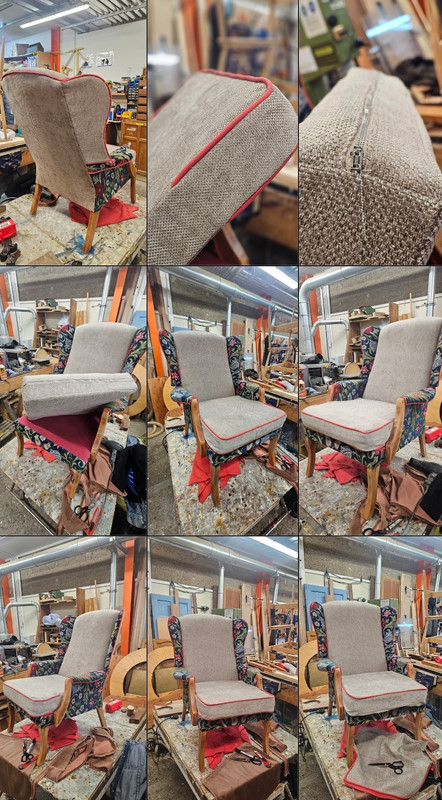
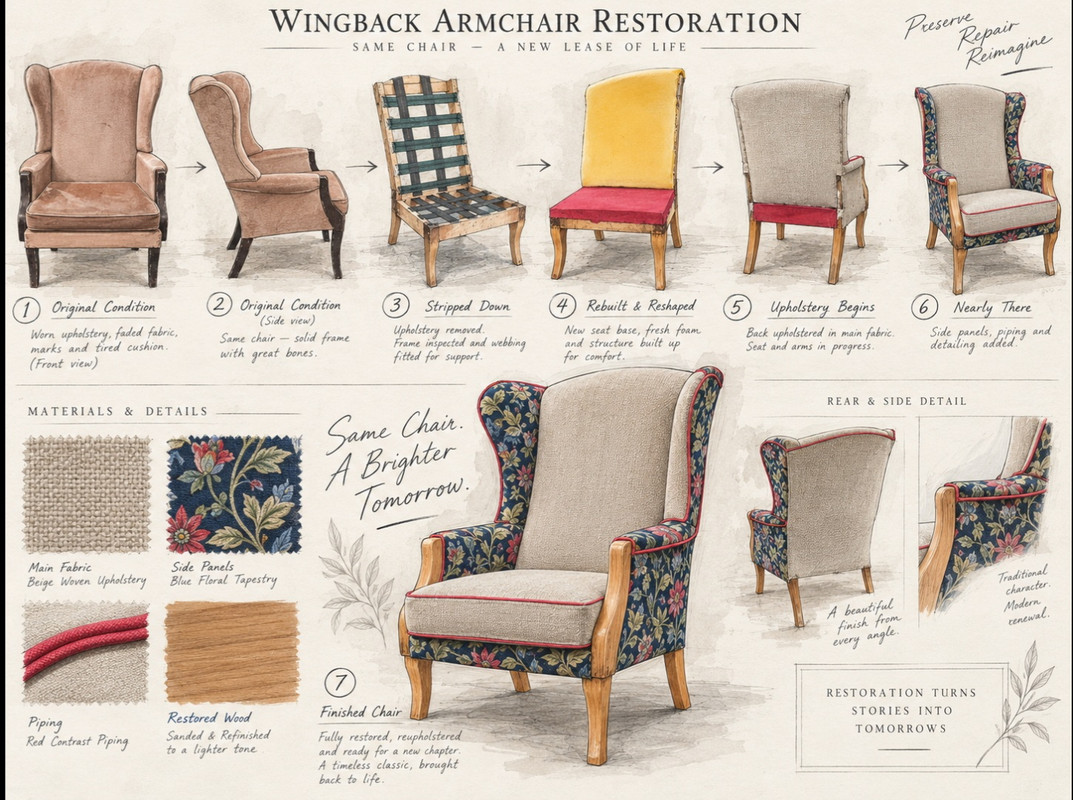
Part One
The Essay
Read straight through. The record of the work, the drawings and the rest of the photographs follow after it.
There are moments when time carries a person forward by a strangely circuitous route — not backward into the past in any literal sense, but toward something far older: the primal relation between a human being and the world, in which hand, material, tool, and time are bound together in a single continuous gesture. It was by this route, unannounced and unplanned, that I came to find myself standing before an old wingback chair.
At first it was nothing more than an object to be taken apart — the fabric to be stripped away, the tacks drawn out one by one, the frame laid bare beneath them, so that one might see what had survived within: where the wood had given way, what had become of the webbing, what could still be trusted to hold and what would have to be made anew. But by degrees, almost without my noticing the transition, the object ceased to be merely a chair and began, instead, to disclose itself as a history.
To take apart an old piece of furniture is to find time made suddenly physical. Beneath one layer lies another: beneath the fabric, canvas; beneath the canvas, the stuffing; and beneath that, in turn, the webbing and the timber itself. Old holes where nails once were. The marks left by tools long since put away. The traces of an earlier repair. The errors of another man's hand. And now and again, unmistakably, the exact and patient work of a craftsman who is himself long gone. It is then that one understands: what lies before you is not a surface at all, but time seen in cross-section.
The hand that remembers
What surprises me more, though, is something else entirely. At a certain point I began to notice that my own hand was changing. The motor skill grew finer; the fingers learned to feel the tension of a fabric, the resistance of a piece of wood, the particular pressure a tool demands. Having worked for a time on the small and exacting details, one approaches the timber differently afterward; and having worked the timber, one comes, in turn, to understand upholstery in a new way. One craft, it seems, quietly instructs another.
A kind of knowledge arises that resists translation into words. One may watch a hundred instructional films on the stretching of a material, and still, in the end, it is the hand alone that must come to feel it: a little more here; enough, now; press harder in this place; do not hurry here of all places. It is a particular species of knowledge, situated somewhere between the body and the conscious mind — and it may be that humanity once possessed this knowledge far more fully, before we began entrusting an ever-greater share of our actions to machines.
Before the factory
For a long stretch of its history, the restoration of furniture did not exist as a distinct profession in anything like the modern sense. The joiners, the cabinetmakers, repaired what they themselves had made; mending was simply the natural continuation of making. In the diary of an American apprentice cabinetmaker, Edward Jenner Carpenter, there survives an entry of almost startling plainness: on the twenty-ninth of May, 1845, the young craftsman noted that he had spent the morning repairing a writing desk. What interests historians of restoration about this small entry is precisely its ordinariness — the young man drew no great distinction between the making of a thing and its continuation.
Traditional upholstery itself is considerably older than the modern furniture industry. Long before foam, synthetic fillings, and the pneumatic staple gun, a chair was built up gradually, by hand, out of layers: webbing, hessian, stuffing, cord, padding — and, in many pieces, springs. Most of these methods took shape in the eighteenth century; sprung construction spread rather later and became part of the European tradition of upholstered furniture-making. This chair had no springs. Its body was held by tensioned webbing alone — simple bands carrying the weight through pull rather than mechanism.
This is a fundamentally different mode of production. A chair was not assembled in a matter of minutes; it came into being gradually, layer upon layer. And so, today, to take apart an old chair is, in effect, to repeat the movements of people who made such things two hundred years before. The technology becomes a form of memory.
The economy disappears
But what I value most now is not, in truth, the technique itself. It is the possibility of making a thing without the constant pressure of the result — without the invisible stopwatch that runs beneath every ordinary economic transaction. How much is an hour worth? How much time does it make sense to spend? Could it be done faster? Would it not be cheaper simply to buy something new? Reckoned by this arithmetic, old furniture nearly always loses; a new object is, in truth, simpler to produce industrially.
But there is another question worth asking: why, exactly, must it be done faster? At the Rediscovery Centre I have found, for now, a rare opportunity to step outside that logic altogether. No one stands beside me with a stopwatch. I may stop. Look. Redo the work. Return to it tomorrow. Try another technique. Learn something I did not know how to do before. And at a certain point one notices an altogether unfamiliar condition: the economy disappears, and the work remains. One does the work not because every minute must be converted into money, but because one wishes to understand the material, and because the process itself is a source of pleasure. It is an almost forgotten form of freedom.
The material, too, has a biography
Something else of consequence occurred with this particular chair. For its new life, I made use of old fabric brought from a castle. And here restoration suddenly became something larger than a technical act of recovery, because the material, too, carries a past. The cloth had another place. Another architecture stood around it. Another light fell upon it. Other people, another air. Now a part of that material finds itself inside the new history of the chair.
A strange chain results: one object completes its original function and becomes part of another. The material does not vanish. It migrates. It is here, precisely, that the hard-to-define magic of handwork appears to me — not mystical in any facile sense, but almost phenomenological. Every object retains the trace of the relations through which it has passed. Someone made the wood. Someone built the chair. Someone sat in it for years. Someone discarded it. Someone kept the fabric from another place entirely. And then all these lines converge, unexpectedly, at a single point: in one's own hands.
The restorer does not begin the story
Modern conservation has arrived, over time, at an important insight: an old object cannot simply be regarded as a spoiled version of a new one. Its alterations become, in themselves, a form of historical evidence. In old furniture, even the placement of nail holes, a remnant of thread beneath a fastening, a fragment of earlier fabric, can testify to the original upholstery and to the changes made to it afterward — which is precisely why contemporary restorers try not to erase such traces without genuine necessity.
This logic is close to my own. A restorer ought not to behave as one who has come to correct the past; he has come, rather, to enter into conversation with it. I find myself understanding restoration less and less as an attempt to make a thing look new. Sometimes an entirely new surface destroys the very thing that was most interesting about the old one. A worn patch may be the memory of a hand. A small dent, the trace of an event. A hole, the evidence of an earlier upholstery. A scar is not always a flaw. Sometimes a scar is a biography.
The grandmother's chair
Imagine a simple chair. For decades it stood in a grandmother's house. A newspaper was read in it. A child was held on someone's knee in it. Someone sat through the night beside a sick relative in it. Someone talked on the telephone in it. Someone simply sat in silence.
Then the household changed. There were fewer people. The chair became unnecessary. The logic of our time says: throw it out. Buy another. The new one will be cleaner, lighter, cheaper. But if one takes the old chair apart, strengthens its joints, renews its webbing, replaces its worn layers, preserves its wood, selects a new fabric — something more interesting occurs. We are not returning the chair to the past. We are giving it the possibility of continuing forward. Someone else will now sit in it. But within it, the old wood will remain. The traces of earlier fastenings. A part of the earlier construction. Perhaps even a small dent that no one but the family would ever notice. This is no longer merely furniture. It is material memory.
The thing against consumption
We have grown accustomed to speaking of a thing's second life. But the phrase, it seems to me, is not quite exact. Why second? A thing may have ten lives. The wood was once wood. Then it became a board. The board became a chair. The chair belonged to one house, and then to another. It was repaired. Reupholstered. Painted. Forgotten. Found again. A century later, someone else took it apart down to the frame once more. A thing is continually changing its states.
We live within a culture in which an object is most often regarded as a brief episode of consumption: bought, used, discarded. But an entirely different culture is possible — not a culture of consumption, but a culture of continuation. The question then becomes, not how much is this thing still worth, but what else might yet happen to it. For the Rediscovery Centre, this idea is particularly natural. Rediscovery is, quite literally, a rediscovering — not merely the recycling of material, but the rediscovery of value itself.
Joseph and the tekton
There is one more ancient image that arises, unbidden, alongside all of this. Joseph, in the Christian tradition, is known as a carpenter. But the Greek word tekton, used in the Gospel context, meant something broader — a master of building or craft in general.
It is not the religious illustration that interests me here, but the archetype itself. A man stands before matter. The wood resists him. He must come to understand it. One cannot persuade wood with words. One cannot negotiate with a joint; if it is made badly, it will come apart. If the fabric is stretched wrongly, it will show the error. Material possesses a remarkable honesty. Perhaps this is why craft has, for centuries, been bound up not only with labor but with an inward discipline. The hand, gradually, educates the man.
The digital biography of a thing
There is another oddity peculiar to our own time. After restoration, the old chair acquires something it never possessed before: a digital memory of its own. I made a separate page devoted to this process, and, quite suddenly, a traditional craft of the eighteenth and nineteenth centuries finds itself standing beside HTML, photography, and the internet. I am fond of this contradiction. The hand works in the old manner; the digital technology preserves the path that hand has taken.
Ordinarily, one sees only the finished chair. But the page allows a different kind of witness to remain: what it once was; how it was taken apart; what materials were found inside; how the wood was restored; how the new upholstery was built up; what decisions were made along the way. What is preserved, in other words, is not merely the object, but the process of the object's becoming. And it may be precisely here that the old craft meets our own time most naturally — not the machine replacing the hand, but the technology becoming a witness to it.
Time without a clock
Perhaps the most unexpected outcome of all this work has been my own altered sense of time. One may spend several hours over some small part of the chair without any sense that time has been lost. Quite the opposite: it grows denser.
For the person of our era, time is ordinarily bound up with results — what was accomplished, what was gained, what was earned. But there exists another kind of time: the time of process. The Greeks distinguished chronos, sequential, measurable time, from kairos, the moment at which something must occur precisely now. It seems to me that craft, on occasion, returns a person to precisely this condition. The clock continues to run. But you cease to belong to it. There is wood. There is fabric. There is the movement of a hand. There is a task. There is silence. And this is enough.
I do not know where this work will finally lead me. Perhaps, in time, I will turn to entirely different things. But for now I feel a certain gratitude for a rare conjunction of circumstances. The stars have, in some fashion, genuinely aligned to grant me the chance to do this now — not to hurry, to learn, to err, to redo, to work with my hands, and to take pleasure not only in the result but in the very act of dwelling inside the process. This is a considerable good. For it sometimes happens that a person believes he has chosen a new occupation, only to discover, later, that the occupation was what had need of him.
When the chair is at last finished, most people will see a single object: a beautiful old chair with a new life. But I, I suspect, will see several things at once. The old wood. The traces of an earlier craftsman. The webbing. Days of labor. Mistakes. New skills. Fabric that arrived from another place, bearing its own history. The Rediscovery Centre. My own hands. And that strange condition, in which, for several hours at a stretch, the need to hurry anywhere at all simply ceased to exist.
So I am no longer certain it is right to say: I restored a chair. Something more reciprocal seems to have occurred. I gave the chair back its form. And the chair, little by little, gave form back to my hand. And in this, perhaps, lies the deepest sense of restoration.
We preserve old things not because we are afraid to part with the past. We preserve them because the past is still capable of working within the future.
Restoration isn't a return to the past.It's permission for the past to have a future.
Part Two
The Record of the Work
What the essay passes over quickly: the condition it arrived in, the order of undoing, the structure underneath, and the photographs taken at the bench.
i — As it came in
The condition, and the order of undoing
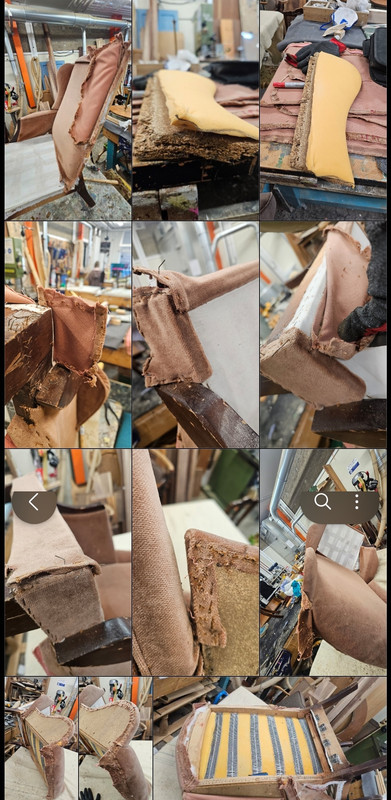
It came in tired. The cover had faded unevenly, thinned along the front edge of the seat, over the tops of the arms and down the leading edges of the wings — the four places a body actually touches. The seat had settled and stopped coming back. The show wood was dry, and the old finish had clouded and broken down in patches. None of this was damage in the structural sense. It was the ordinary arithmetic of use.
Underneath, the news was better than it looked. The frame was sound: tight through most of its joints, with local movement in only a few, and no significant loss of timber anywhere. What had failed were the consumable layers — the parts of an upholstered chair designed from the outset to be renewed. The chair had not failed. Its consumables had, which is a different sentence entirely, and the one that decides whether a piece is worth the hours.
Nothing is torn off. An upholstered chair is assembled outward from the frame, so it is undone in exactly the reverse order, and each piece comes away whole. This is not fastidiousness. The old panels become the patterns for the new ones; the tack lines show precisely where tension was carried and at what angle; the way a corner was pleated tells you how the original maker solved that corner. Destructive stripping loses information that cannot be recovered afterwards at any price.
- 01Outside back, then outside armsThe last pieces fitted are the first removed. Fixings drawn rather than levered, so the rail edge is not chewed.
- 02Cover panels off the insideInside back, inside arms, seat. Each panel kept flat and labelled — it is a template now, not waste.
- 03Fillings liftedThe stuffing comes away in the order it was built up. The original profile is read off it before it is discarded.
- 04Hessian and the old webbing cut awayFrom the underside. The perished bands are the reason the seat had stopped returning.
- 05Frame cleared and readDecades of fixings leave a rail edge that has to be cleaned and consolidated before anything new will hold.
- 06Joints tested, one at a timeMovement found is cleaned, re-secured and blocked. Reinforcement goes only where the frame asks for it.
ii — The red line
Care becomes visible at the edge
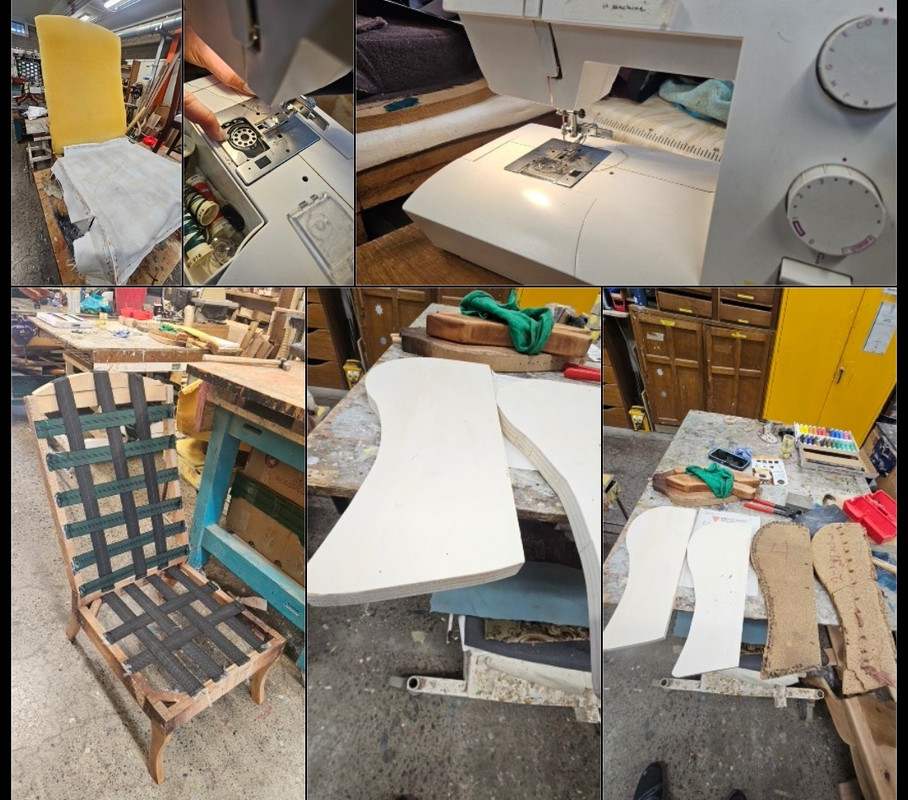
Almost nothing that decides how a chair is read happens in the middle of a panel, where the cloth simply lies. It happens along the line where one plane turns into another. That line is drawn with piping: a cord wrapped in a strip cut on the bias, sewn close along its length, then set into the seam and worked round every curve by hand.
The strip has to be cut on the bias — diagonally across the weave — because only then will it travel round a curve without puckering. Cut it straight and it fights the first corner it meets. Sew a little wide of the cord and the finished edge goes soft and reads as sloppy from across a room. There is no way to hurry any of it, and no way to hide it afterwards.
It is also structural, which people forget. Piping set into a seam strengthens the join and takes the wear that would otherwise fall on the cloth itself. It is the part of the chair most likely to be rubbed by a sleeve for the next thirty years, and the part that can be replaced on its own without disturbing anything else. Continuity, built into an edge.
iii — The hidden structure
What holds the form is the part nobody sees
Webbing holds the form This chair had no springs. Its body was held by tensioned webbing alone — simple bands strained across the frame with a stretcher and interlaced over and under, so that the seat becomes a woven plane rather than a set of parallel straps.
Nothing beneath the seat moves. The form is carried by pull, not by mechanism. It is the simpler and more direct of the two traditions, and it stakes everything on the tension of a few strips of cloth: get that wrong and no amount of good covering will rescue the chair.
Seat and back are not strained alike, either. A seat is set firm because it resists weight; a back is set softer because it has to give. Getting that relationship right is most of what people mean when they say a chair sits well — and it is settled entirely in a layer no one will ever see again once the cover goes on.
Drag to turn · scroll or pinch to zoom · arrow keys work too
The chair, taken apart
This chair, modelled from its own parts. Turn it, zoom in, and pull the slider to lift it apart layer by layer. Choose a part to see only that one.
- Wings & floral panelsoutside arms, outside back
- Pipingthe red line
- Neutral coverseat, inside back, arms
- Stuffing & paddingthe volume
- Hessianthe ground
- Webbinginterlaced · no springs
- Show woodarm supports, legs
- Framethe carcass nobody sees
iv — Drawn, not photographed
The atlas, and the hands
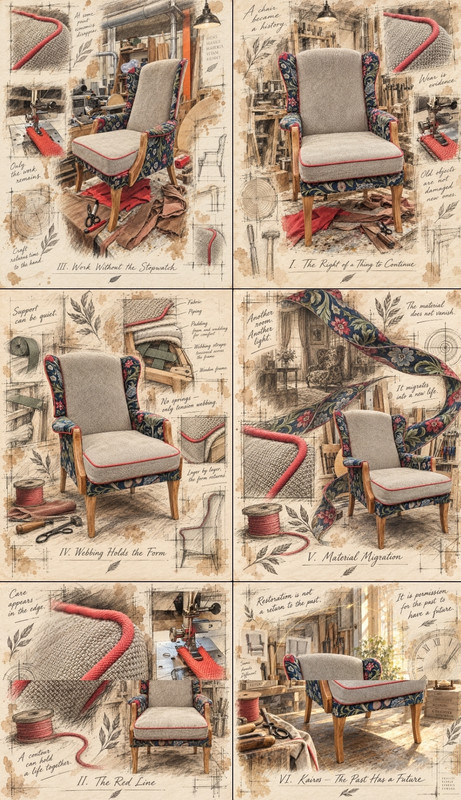
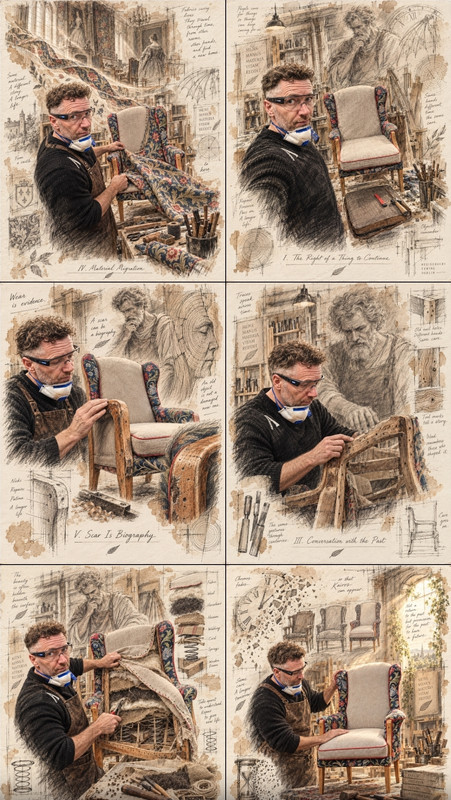
Six panels standing for the six ideas the work kept returning to, and a second sheet in which the work itself is shown being done — handling, examining, lifting away, with the sense of an earlier hand somewhere behind it.
v — The film
The transformation in motion
Part Three
The Room
Where all of it ends: an ordinary act, in a room built for formality.
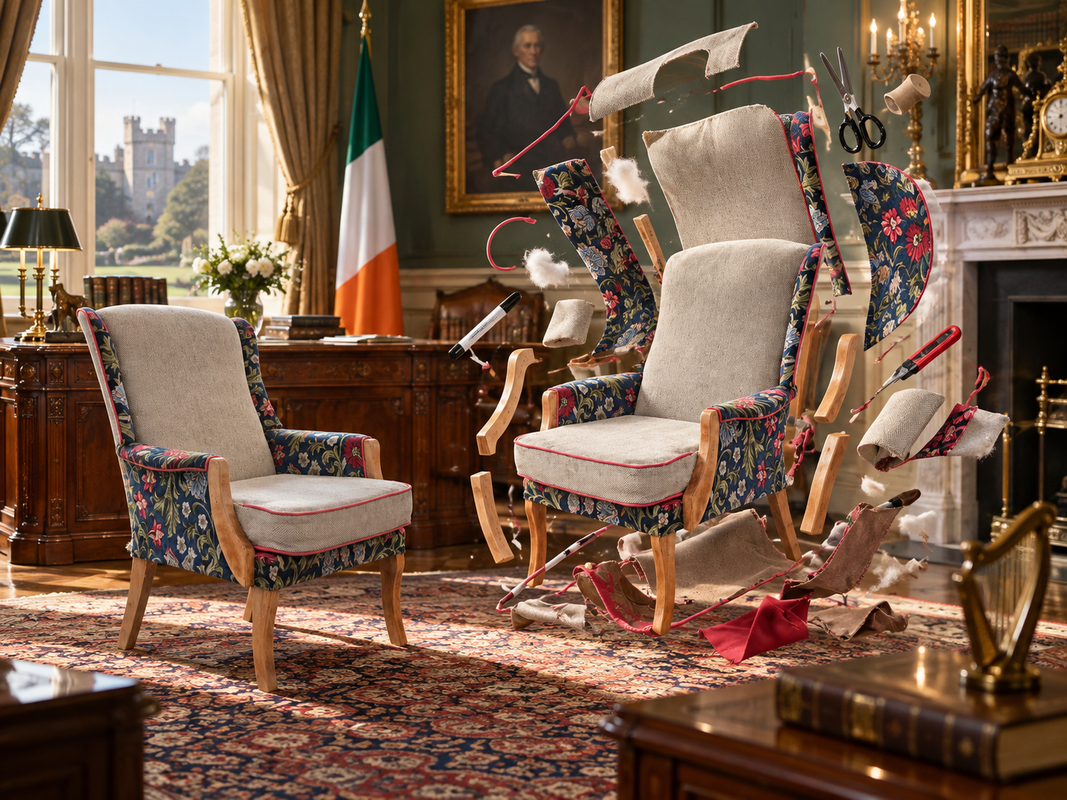
We are used to the idea that dignity belongs to new things, and that a repaired object is a compromise kept out of sight. Put the chair in a room built for formality and that assumption inverts. Nothing about it needs to be explained away. The seams are hand-closed, the timber is the timber it always was, the frame is the frame somebody made decades ago — and it sits there without apology.
All of the work ends in an entirely ordinary act. Somebody sits down. That is the whole purpose of the object, and the only test it ever has to pass.
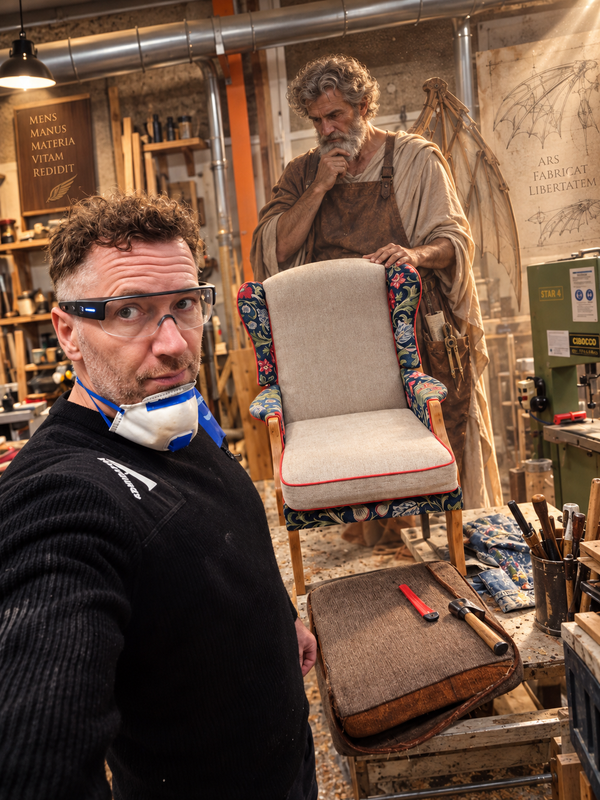
- Object
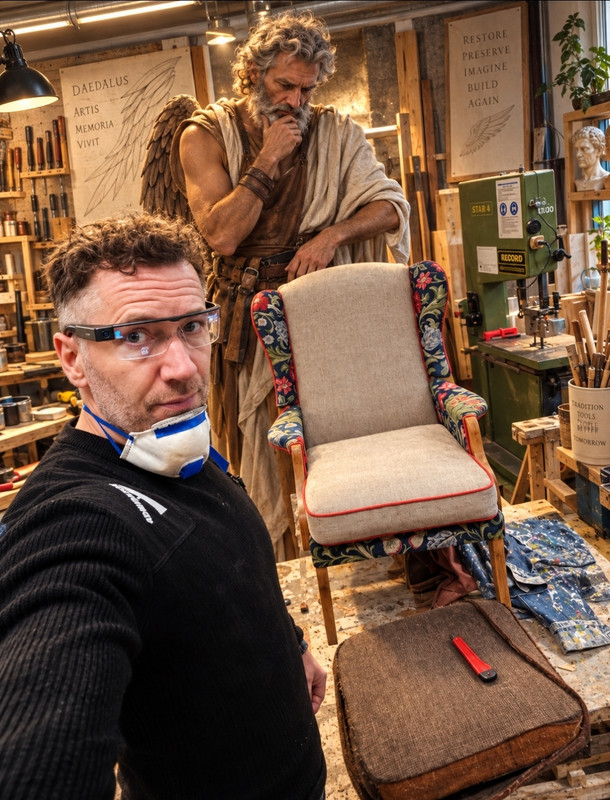
- Vintage wingback armchair. Provenance unestablished — no maker's mark, and none claimed.
- Structure
- Tensioned webbing throughout. No springs.
- Process
- Dismantled · inspected · re-webbed · reinforced · sanded · waxed · rebuilt in layers · upholstered · piped · hand-stitched
- Materials
- Neutral grey ground cloth · decorative floral panels, part of the cloth brought from a castle · contrast piping over cord · renewed webbing · original timber, cleaned and waxed
- Place
- Rediscovery Centre, Furniture Department, Ballymun, Dublin
ADC ✍Dublin · Rediscovery Centre · 2026